|
ATOMIC BOMBARDMENT
(1932-1938)
Events >
Atomic Discoveries, 1890s-1939
In the 1930s,
scientists
learned a tremendous amount about the structure of the
atom by bombarding it with sub-atomic particles.
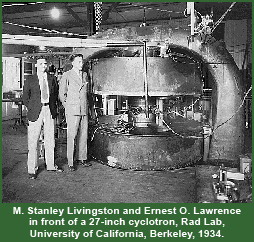
Ernest O. Lawrence's
cyclotron, the
Cockroft-Walton machine, and the Van de Graaff generator, developed by Robert J.
Van de Graaff at Princeton University, were
particle accelerators
designed to bombard the nuclei of various elements to
disintegrate atoms. Attempts of the early 1930s to
split atoms, however, required huge amounts of energy
because the first accelerators used
proton beams
and
alpha particles
as sources of energy. Since protons and alpha
particles are positively charged, they
met substantial resistance from the positively charged
target
nucleus
when they attempted to penetrate atoms. Even
high-speed protons and alpha particles scored direct hits
on a nucleus only approximately once in a million
tries. Most simply passed by the target
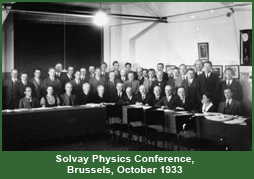
nucleus. Not surprisingly, Ernest Rutherford, Albert
Einstein (right), and Niels Bohr regarded particle
bombardment as useful in furthering knowledge of nuclear
physics but believed it unlikely to meet public
expectations of harnessing the power of the atom for
practical purposes anytime in the near future. In a
1933 interview, Rutherford called such expectations
"moonshine." Einstein compared particle bombardment
with shooting in the dark at scarce birds, while Bohr, the
Danish Nobel laureate, agreed that the chances of taming
atomic energy were remote.
Rutherford, Einstein, and Bohr proved to be wrong in this
instance, and the proof was not long in coming.
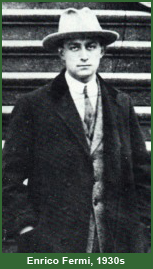
Beginning in 1934, the Italian physicist
Enrico Fermi
began bombarding elements with
neutrons
instead of protons, theorizing that Chadwick's uncharged
particles could pass into the nucleus without
resistance. Like other scientists at the time, Fermi
paid little attention to the possibility that matter might
disappear during bombardment and result in the release of
huge amounts of energy in accordance with Einstein's
formula,
E=mc2, which stated that mass and energy were
equivalent. Fermi and his colleagues bombarded
sixty-three stable elements and produced thirty-seven new
radioactive ones. They also found that carbon and
hydrogen proved useful as moderators in slowing the
bombarding neutrons and that slow neutrons produced the
best results since neutrons moving more slowly remained in
the vicinity of the nucleus longer and were therefore more
likely to be captured.
One element Fermi bombarded with slow neutrons was
uranium, the heaviest of the known elements.
Scientists disagreed over what Fermi had produced in this
transmutation. Some thought that the resulting
substances were new "transuranic" elements, while others
noted that the chemical properties of the substances
resembled those of lighter elements. Fermi was
himself uncertain. For the next several years,
attempts to identify these substances dominated the
research agenda in the international scientific community,
with
the answer coming out of Nazi Germany just before
Christmas 1938.
Previous Next
Sources and notes for this page.
The text for this page was adapted from, and portions
were taken directly from the
Office of History and Heritage Resources
publication:
F. G. Gosling,
The Manhattan Project: Making the Atomic Bomb
(DOE/MA-0001; Washington: History Division, Department
of Energy, January 1999), 1-2. The "moonshine" comment is from Lawrence
Badash, "Introduction," in
Reminiscences of
Los Alamos, 1943-1945, edited by Lawrence Badash, Joseph O. Hirschfelder,
and Herbert P. Broida (Dordrecht, Holland: D. Reidel
Publishing Company, 1980), xi. For Niels Bohr's
views, see "Neutron Capture and Nuclear Constitution,"
Nature 137 (1936), 344. For more on
Enrico Fermi's experiments, see William R. Shea, "Introduction:
From Rutherford to Hahn," in
Otto Hahn and the Rise of Nuclear Physics,
edited by William R. Shea (Dordrecht, Holland: D. Reidel
Publishing Company, 1983), 15. "Atomic" and
"nuclear" are basically synonymous; much as the term
"pile" gradually gave way to "reactor," "atomic" was
gradually replaced by "nuclear" during the later years
of the Manhattan Project and afterwards. The
photograph of the 27-inch
cyclotron
is courtesy the
Department of Energy
(via the
National Archives). Click
here for more information on the Solvay conference. The portrait of Einstein is courtesy the
Library of Congress; it
was taken in 1947 by Oren Jack Turner; its copyright was
not renewed. The photographs of Enrico Fermi are
courtesy the
Argonne National Laboratory.
Home |
History Office
|
OpenNet
|
DOE
|
Privacy and Security Notices
About this Site
|
How to Navigate this Site
|
Note on Sources
|
Site Map |
Contact Us
|