
Places
"Met Lab"
(Metallurgical
Laboratory)
THE CHOICE OF LOS ALAMOS, NM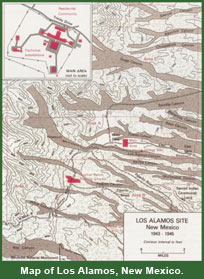 (1942)
Places > LOS ALAMOS: THE LABORATORY
In December 1941, Arthur Compton assumed overall responsibility for weapon theory and the chain reaction for producing plutonium. Compton soon established the Metallurgical Laboratory (Met Lab) at the University of Chicago in order to consolidate chain reaction research, but he left fast-neutron research, looking toward bomb development, dispersed at a half-dozen universities. With bomb research languishing, Compton in June 1942 appointed J. Robert Oppenheimer to head up the fast-neutron program. Oppenheimer found the disjointed character of the effort alarming. Working in widely separated laboratories, the scientists knew very little about work elsewhere. Confusion prevailed in the vital field of cross-section measurements, with as many values as there were laboratories. Oppenheimer determined that achieving dependable results meant bringing the team together. Researchers could then compare findings and correct each other's errors. Convinced that consolidating research at the Met Lab was not the answer because it was too compartmentalized, Oppenheimer concluded that a special laboratory was the only way to achieve a coordinated effort. 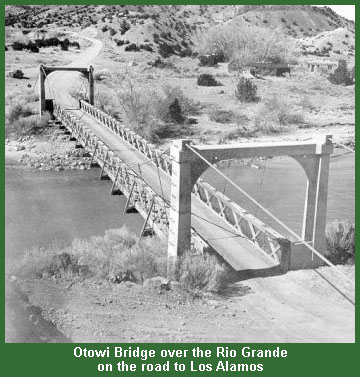
Not long after General Leslie Groves assumed command of the Manhattan Engineer District in September 1942, Oppenheimer suggested establishing a special bomb laboratory. He stressed the necessity for free internal communication, conceding that this meant tight controls to prevent leaks to the outside. Groves, who was instinctively security-minded, found the idea attractive. He recognized that ordnance experiments eventually would require a remote proving ground, and there were obvious security advantages in isolating the bomb research at some secluded hideaway. After the two men further discussed the idea with Compton and Vannevar Bush, Groves on October 19 approved going forward with the special laboratory. Pleased with what had been accomplished, Oppenheimer told Groves that this step would "bear good fruit in the future." Inaccessibility was the most important criteria in selecting the site. Some road and not-too-distant rail facilities were needed, but since the weapons work was not expected to require a large installation, convenience could be sacrificed for the benefits of isolation. The objective was a remote inland site where the Army could apply the most rigid of external security measures. Other site requirements included a climate that would permit year-round construction, access to power and water, sufficient size for an adequate testing ground, location in a sparsely populated area for reasons of safety as well as security, land relatively easy to acquire, and already sufficient buildings to house most of what was anticipated would be a comparatively small staff. 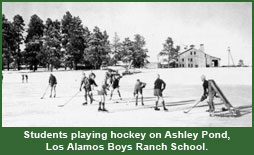
Oppenheimer and Compton discussed placing the laboratory at the Oak Ridge, Tennessee, site, and Groves briefly considered a site near Los Angeles and another on the California-Nevada border near Reno, but the search soon narrowed to the southern Rockies and a string of five possibilities stretching for 200 miles across northern New Mexico. Surveys reduced the choice to two locations, Jemez Springs about 50 miles north of Albuquerque and the Los Alamos Ranch School, a private academy for boys further east and north. On November 16, Oppenheimer, who owned a ranch east of Santa Fe and was familiar with the area, and Edwin McMillan, a colleague at the University of California, inspected the Jemez Springs site on horseback. McMillan did not think the site suitable. Located deep in a narrow valley, Jemez Springs did not offer enough space for a rational layout and was vulnerable to floods. When Groves arrived later in the day, he agreed. The men then proceeded by automobile to the Los Alamos School, on the cone of a massive, ages-extinct volcano. To the west were the Jemez Mountains, the rim of the crater. Radiating from the crest of the mountains were dozens of deep canyons cut into the soft yellow tuff. The school sat on a mesa between two canyons. Eastward the land sloped down to the Rio Grande, and on the far side rose the snow-covered peaks of the Sangre de Cristo Range. Santa Fe, the nearest railhead and community of any size, lay, barely visible, 20 miles to the southeast. Roads were poor, water resources were questionable, and power supply caused some concern, but other factors counterbalanced these. A more inaccessible site than the mesa with its steep rock walls and bad roads would have been difficult to find. Plenty of space for safe testing existed in the adjacent canyons and nearby mesas. Most of the land required was public domain, while, aside for the school, the rest was valuable only for grazing and would cost little. The school itself was in serious financial trouble, and the owners were willing to sell. In addition, the school buildings would be available for housing. Groves decided quickly that this was the place. A week later, Oppenheimer and McMillan, along with Ernest Lawrence, again inspected the site and made recommendations on possible locations for laboratories and housing. "Lawrence was pleased by the site," Oppenheimer reported to Groves, "and so, again, were we." That same day, Groves acquired right of entry to the lands and property of the school. On November 25, he obtained authority to acquire the site. Before the end of the month, he had assigned supervision of initial construction to the district engineer in Albuquerque. By the end of December, Groves had persuaded the University of California to take responsibility for procuring supplies and employing personnel. The entire operation was carried out, Oppenheimer later noted, "with unbelievable dispatch."
|

The text for this page is original to the Department of Energy's Office of History and Heritage Resources. For further information, see Richard G. Hewlett and Oscar E. Anderson, Jr., The New World, 1939-1946: Volume I, A History of the United States Atomic Energy Commission (Washington: U.S. Atomic Energy Commission, 1972); Lillian Hoddeson, et. al., Critical Assembly: A Technical History of Los Alamos during the Oppenheimer Years, 1943-1945 (Cambridge: Cambridge University Press, 1993); and Manhattan District History, Book VIII - Los Alamos Project (Y), Volume 1- General. The map of Los Alamos is reprinted from Vincent C. Jones, Manhattan: The Army and the Atomic Bomb, United States Army in World War II (Washington: Center of Military History, United States Army, 1988), 330. The photograph of the students playing hockey on Ashley Pond is reprinted from "Dateline: Los Alamos," a special issue of the monthly publication of LANL (1995), 7.