
People
WOMEN'S ARMY CORPS (WAC) (Manhattan Engineer District, 1943-1946)
People > Military Organizations
In spring 1943, General Leslie Groves requested that a detachment of the Women's Army Auxiliary Corps, which became the Women's Army Corps (WAC) on September 30, be assigned to the Manhattan Engineer District (MED). The "one primary reason" was due to the urgent need for additional military personnel to handle classified mail and records. The processing of mail and records, Groves noted, provided such a broad view of project activities that it had to be limited to personnel under strict military control. 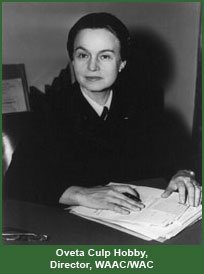
Although one WAC officer was assigned to the Manhattan Project in fall 1942, the first WAC detachment was activated at Fort Sill, Oklahoma, on April 17, 1943, and the initial members reported to the Los Alamos laboratory a few days later. WAC personnel arrived at the Oak Ridge site in June. WACs also would be stationed at the Hanford site, Washington D.C., and New York City. Three WACs worked at the MED's London office, which reported directly to Groves. WACs assigned to the Manhattan Project were hand-picked by their commanding officer, Captain Arlene Scheidenheln, who was stationed at the MED administrative headquarters at Oak Ridge but oversaw the WACs at all of the MED installations. At Oak Ridge, the WACs maintained the classified files and operated the teletype files. Although the WACs handled highly classified materials and knew the project was important, they were not privy to the secret details or the overall nature of the project. Due to the significance of their work, life for the WACs at Oak Ridge was different than that for WACs at most other Army post. As with other employees of the MED, they could not discuss their work outside of the workplace, but they also did not have to perform extra duties such as regular drill and kitchen police ("KP"). In addition, they had maids to keep their barracks clean. Nonetheless, the security was strict and the hours long. As one WAC in the teletype division noted, "we had only two shifts and operated 24 hours a day, seven days a week." Groves later observed that the WACs "had performed the hardest type of Army duty and WAC has been called upon to do because it was hard work and long hours over a long period of time with no recognition and no chance to talk about their jobs." 
At other MED sites, the work varied considerably. WACs not only handled classified material but also performed a wide assortment of other jobs, ome of them highly technical and scientific. At Los Alamos, the working program for WAC's was not well defined at first, and all were put on "basic jobs," although many of them had technical qualifications. Over time, however, they were placed in practically every department at the site. Several were engaged in scientific research, and many, as at Oak Ridge, were in positions handling highly classified material. WACs also were librarians, clerks, telephone operators, cooks, and drivers. Approximately twenty medical WACs served as hospital technicians. The WAC detachment at Oak Ridge numbered close to 275. At Los Alamos, it peaked in size at 260 in August 1945, but in post-war years it shrunk rapidly until its disbandment in October 1946. To view the next people section of the Manhattan Project, proceed to Non-Technical Personnel.
|

The text for this page is original to the Department of Energy's Office of History and Heritage Resources. Major sources consulted include the following. Vincent C. Jones, Manhattan: The Army and the Atomic Bomb, United States Army in World War II (Washington: Center of Military History, United States Army, 1988), 357-58, 473; Manhattan Project (War Department) press release, "432 WACs Assigned to Manhattan Project," August 13, 1945, in Manhattan District History, Book I - General, Volume 4 - Auxiliary Activities, Chapter 8 - Press Releases, Part I, also available on the University Publications of America microfilm collection, Manhattan Project: Official History and Documents (Washington: 1977), reel #1/12, "we had only two shifts…" quote and Groves quote from the press release; Manhattan District History, Book I - General, Volume 8 - Personnel, Section 7, 7.2, 7.9-7.10, "one primary reason" p. 7.2; Manhattan District History, Book VIII - Los Alamos Project (Y), Volume 1 - General, Section 6, 6.19, Section 7, 7.4-7.5, adapted and reprinted as Edith C. Truslow, with Kasha V. Thayer, ed., Manhattan Engineer District: Nonscientific Aspects of Los Alamos Project Y, 1942 through 1946 (Los Alamos, NM: Manhattan Engineer District, ca. 1946; first printed by Los Alamos Scientific Laboratory as LA-5200, March 1973; reprinted in 1997 by the Los Alamos Historical Society), 105, 2nd Lieutenant Edith C. Truslow, a member of the Women's Army Corps, wrote the Manhattan District History volume in 1946. The photograph of the WACs marching at Oak Ridge, June 1945, is courtesy the Army Corps of Engineers; it was reprinted in Rachel Fermi and Esther Samra, Picturing the Bomb: Photographs from the Secret World of the Manhattan Project (New York: Harry N. Abrams, Inc., Publishers, 1995), page 40. The photograph of Hobby is courtesy the Library of Congress; it was taken by Harris and Ewing ca. February 1953, copyright not renewed. The photograph of the three WAC members is courtesy the Los Alamos National Laboratory.