
People
MILITARY POLICE (Manhattan Engineer District, 1942-1946)
People > Military Organizations
Military police (MP) were assigned to the three major Manhattan Project sites. At the Oak Ridge and Hanford sites, the MP provided constant military guard over certain technical and restricted areas and protected against any unforeseen emergencies that might arise. Arrangements were made between General Leslie Groves, head of the Manhattan Engineer District, and the chief of staff of the Army Service forces on June 24, 1944, providing for one MP company (usually 62 to 190 soldiers) at each of the two sites. The two companies arrived at the sites in early July. The Los Alamos laboratory differed from the other two sites in that it was set up as a military post due to the direct military nature of the work and the need for absolute security. With the lab as a military installation, the MP would play a more significant role. For the first month or so of the lab's existence, civilian guards were assigned to internal security. The MP detachment, with an original strength of 196 men and 7 officers, arrived in late April 1943 to assume guard duty. Numbers increased as the lab expanded, with a wartime high of 486 soldiers and 9 officers. The MP at Los Alamos were responsible for physical security consisting of two primary lines of defense. The fenced outer perimeter encompassed the community and the Main Technical Area. The inner perimeter consisted of the Main Technical Area. Military police guarded the two entrances to the reservation and the three entrances to the Technical Area. They also guarded several satellite technical areas warranting extra protection. Until the end of 1943, half of the MP guards were posted inside the Technical Area, guarding special buildings and the incomplete inner perimeter fence line. With the completion of the fence, military jurisdiction ended officially at this second fence. The MP guards, who did not have security clearances, were forbidden to enter unless they were escorting an uncleared civilian visitor. The perimeter fence to the Technical Area consisted of a 9½-foot-high woven-wire fence, with two barbed-wire top strands, an automatic alarm system attached to the fence, and 159 1500-watt mounted flood lights to light the vicinity. 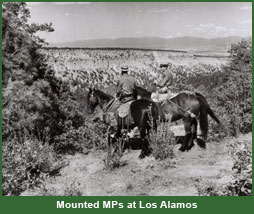
The MP patrolled the area between the two fences and the parts of the reservation outside of the outer perimeter fence on a 24-hour basis. Guards used jeeps to roam the site, and the initial detachment had been organized with a mounted section, with the expectation that mounted sentries would be required. As many as 6 mounted posts were in effect, but they were found to be impracticable and the last was abandoned in January 1944. After that, the 134 horses gradually were reduced in number by disposal and transfer until no more remained. The MP also constituted the primary law enforcement officers at the site. The Motor Patrol Section patrolled the roads, apprehended traffic violators, issued summonses for appearances before the court, and testified in resultant proceedings. In 1945, a unit of MP manned the Trinity site on the Alamagordo Bombing Range. The unit was in charge of security for the testing installations during the preparatory stages for and the actual testing of the plutonium device on July 16, 1945.
|

The text for this page is original to the Department of Energy's Office of History and Heritage Resources. Major sources consulted include the following. Vincent C. Jones, Manhattan: The Army and the Atomic Bomb, United States Army in World War II (Washington: Center of Military History, United States Army, 1988), 486; Lillian Hoddeson, et al., Critical Assembly: A Technical History of Los Alamos during the Oppenheimer Years, 1943-1945 (Cambridge: Cambridge University Press, 1993), 93-96; Manhattan District History, Book I - General, Volume 8 - Personnel, Section 7, 7.2-7.3; Manhattan District History, Book VIII - Los Alamos Project (Y), Volume 1 - General, Section 6, 6.33-6.35, 6.49-6.52, Section7, 7.3, 7.11, adapted and reprinted as Edith C. Truslow, with Kasha V. Thayer, ed., Manhattan Engineer District: Nonscientific Aspects of Los Alamos Project Y, 1942 through 1946 (Los Alamos, NM: Manhattan Engineer District, ca. 1946; first printed by Los Alamos Scientific Laboratory as LA-5200, March 1973; reprinted in 1997 by the Los Alamos Historical Society), 80-81, 93-94. Both the image of the MP checking the badge and the image of the mounted MPs are courtesy Los Alamos National Laboratory.