Use of a Mylar filter to eliminate vacuum ultraviolet pulse pileup in low-energy x-ray measurements
Journal Article
·
· Review of Scientific Instruments
- Princeton Fusion Systems, Inc., Plainsboro, NJ (United States); Princeton Fusion Systems, Inc.
- Princeton Univ., NJ (United States)
- Princeton Fusion Systems, Inc., Plainsboro, NJ (United States)
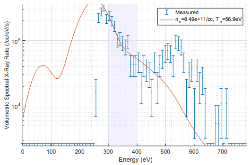
We describe a method to reduce vacuum ultraviolet (VUV) pulse pileup (PPU) in x-ray pulse-height Silicon Drift Detector (SDD) signals. An Amptek FAST SDD, with C1 (Si3N4) window, measures bremsstrahlung emitted from PFRC-2 plasma to extract the electron temperature (Te) and density (ne). The C1 window has low transmissivity for photons with energy below 200 eV though will transmit some VUV and soft x-ray photons, which PFRC-2 plasmas abundantly emit. Multi-VUV-photon PPU contaminates the interpretation of x rays with energy > 100 eV, particularly in a low-energy exponential tail. The predicted low transmissivity of ~1 μm thick Mylar [polyethylene terephthalate (PET)] to photons of energy <100 eV led to the selection of Mylar as the candidate filter to reduce VUV PPU. Experiments were conducted on an x-ray tube with a graphite target and on a quasi-Maxwellian tenuous plasma (ne ~ 109 cm–3) with effective temperatures reaching 1500 eV. A Mylar filter thickness of 850 nm is consistent with the results. The Mylar-filter-equipped SDD was then used on the PFRC-2 plasma, showing a substantial reduction in the low-energy x-ray signal, supporting our hypothesis of the importance of VUV PPU. Here, we describe the modeling and experiments performed to characterize the effect of the Mylar filter on SDD measurements.
- Research Organization:
- Princeton Fusion Systems, Inc., Plainsboro, NJ (United States)
- Sponsoring Organization:
- USDOE Advanced Research Projects Agency - Energy (ARPA-E)
- Grant/Contract Number:
- AC02-09CH11466; AR0001099
- OSTI ID:
- 1890157
- Alternate ID(s):
- OSTI ID: 1890515
- Journal Information:
- Review of Scientific Instruments, Journal Name: Review of Scientific Instruments Journal Issue: 9 Vol. 93; ISSN 0034-6748
- Publisher:
- American Institute of Physics (AIP)Copyright Statement
- Country of Publication:
- United States
- Language:
- English
The historical development of the thermoelectrically cooled X-ray detector and its impact on the portable and hand-held XRF industries (February 2009)
|
journal | March 2010 |
RF Plasma Heating in the PFRC-2 Device: Motivation, Goals and Methods
|
conference | January 2011 |
Using Poisson-regularized inversion of Bremsstrahlung emission to extract full electron energy distribution functions from x-ray pulse-height detector data
|
journal | February 2018 |