Predicting strength distributions of MEMS structures using flaw size and spatial density
Journal Article
·
· Microsystems & Nanoengineering (Online)
- National Inst. of Standards and Technology (NIST), Gaithersburg, MD (United States). Materials Measurement Science Division, Material Measurement Laboratory; DOE/OSTI
- National Inst. of Standards and Technology (NIST), Gaithersburg, MD (United States). Materials Measurement Science Division, Applied Chemicals and Materials Division
- Sandia National Lab. (SNL-NM), Albuquerque, NM (United States). Materials Science and Engineering Center
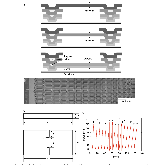
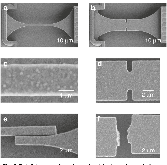
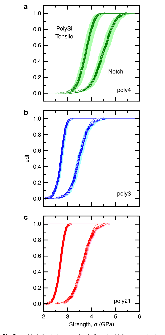
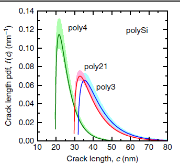
The populations of flaws in individual layers of microelectromechanical systems (MEMS) structures are determined and verified using a combination of specialized specimen geometry, recent probabilistic analysis, and topographic mapping. Strength distributions of notched and tensile bar specimens are analyzed assuming a single flaw population set by fabrication and common to both specimen geometries. Both the average spatial density of flaws and the flaw size distribution are determined and used to generate quantitative visualizations of specimens. Scanning probe-based topographic measurements are used to verify the flaw spacings determined from strength tests and support the idea that grain boundary grooves on sidewalls control MEMS failure. The findings here suggest that strength controlling features in MEMS devices increase in separation, i.e., become less spatially dense, and decrease in size, i.e., become less potent flaws, as processing proceeds up through the layer stack. The method demonstrated for flaw population determination is directly applicable to strength prediction for MEMS reliability and design.
- Research Organization:
- Sandia National Lab. (SNL-NM), Albuquerque, NM (United States); Sandia National Laboratories (SNL-NM), Albuquerque, NM (United States)
- Sponsoring Organization:
- USDOE National Nuclear Security Administration (NNSA); USDOE Office of Science (SC), Basic Energy Sciences (BES)
- Grant/Contract Number:
- NA0003525
- OSTI ID:
- 1624021
- Alternate ID(s):
- OSTI ID: 1870472
- Report Number(s):
- SAND2022-3867J; PII: 93
- Journal Information:
- Microsystems & Nanoengineering (Online), Journal Name: Microsystems & Nanoengineering (Online) Journal Issue: 1 Vol. 5; ISSN 2055-7434
- Publisher:
- Springer NatureCopyright Statement
- Country of Publication:
- United States
- Language:
- English
Effects of nano‐grain structures and surface defects on fracture of micro‐scaled polysilicon components
|
journal | February 2020 |


Similar Records
Shoulder fillet effects in strength distributions of microelectromechanical system components
Predicting fracture in micron-scale polycrystalline silicon MEMS structures.
Journal Article
·
Thu Nov 05 19:00:00 EST 2020
· Journal of Micromechanics and Microengineering. Structures, Devices and Systems
·
OSTI ID:1738922
Predicting fracture in micron-scale polycrystalline silicon MEMS structures.
Technical Report
·
Wed Sep 01 00:00:00 EDT 2010
·
OSTI ID:990954