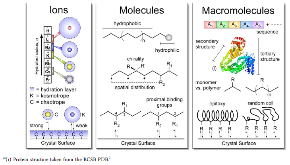
The use of growth modifiers in natural, biological, and synthetic crystallization is a ubiquitous strategy for controlling growth and achieving desired physicochemical properties. For crystals that grow classically (i.e., monomer-by-monomer addition), theories of crystallization are well established and the field of growth modification is rather mature, although many questions remain regarding the molecular driving forces of modifier–crystal interactions. A new frontier in crystallization is the application of classical methods to tailor materials that grow nonclassically (i.e., growth by the addition of species more complex than monomers). A recent surge of interest and activity in this field has been driven by mounting evidence of both inorganic and organic materials that grow via nonclassical pathways. In these systems, the challenge of elucidating the mechanism(s) of crystallization is underscored by a diversity of growth units that far outnumber those available for classical routes. In this Perspective, we consider growth modification in nonclassical crystallization, including examples in the literature, the challenges associated with elucidating the modes of modifier action, and to what degree classical theories can be applied to these complex problems as a means of establishing versatile blueprints for crystal engineering.
@article{osti_1534443,
  author       = {Olafson, Katy N. and Li, Rui and Alamani, Bryan G. and Rimer, Jeffrey D.},
  title        = {Engineering Crystal Modifiers: Bridging Classical and Nonclassical Crystallization},
  annote       = {The use of growth modifiers in natural, biological, and synthetic crystallization is a ubiquitous strategy for controlling growth and achieving desired physicochemical properties. For crystals that grow classically (i.e., monomer-by-monomer addition), theories of crystallization are well established and the field of growth modification is rather mature, although many questions remain regarding the molecular driving forces of modifier–crystal interactions. A new frontier in crystallization is the application of classical methods to tailor materials that grow nonclassically (i.e., growth by the addition of species more complex than monomers). A recent surge of interest and activity in this field has been driven by mounting evidence of both inorganic and organic materials that grow via nonclassical pathways. In these systems, the challenge of elucidating the mechanism(s) of crystallization is underscored by a diversity of growth units that far outnumber those available for classical routes. In this Perspective, we consider growth modification in nonclassical crystallization, including examples in the literature, the challenges associated with elucidating the modes of modifier action, and to what degree classical theories can be applied to these complex problems as a means of establishing versatile blueprints for crystal engineering.},
  doi          = {10.1021/acs.chemmater.6b03550},
  url          = {https://www.osti.gov/biblio/1534443},
  journal      = {Chemistry of Materials},
  issn         = {ISSN 0897-4756},
  number       = {23},
  volume       = {28},
  place        = {United States},
  publisher    = {American Chemical Society (ACS)},
  year         = {2016},
  month        = {09}}
Philosophical Transactions of the Royal Society A: Mathematical, Physical and Engineering Sciences, Vol. 243, Issue 866https://doi.org/10.1098/rsta.1951.0006