Structural and Optical Interplay of Palladium-Modified TiO 2 Nanoheterostructure
Journal Article
·
· Journal of Physical Chemistry. C
- Department of Chemistry, University of Western Ontario, 1151 Richmond Street, London, Ontario N6A5B7, Canada
- Advanced Light Source, Lawrence Berkeley National Laboratory, Berkeley, California 94720, United States; National Synchrotron Radiation Laboratory and Collaborative Innovation Center of Suzhou Nano Science and Technology, University of Science and Technology of China, Hefei, Anhui 230029, People’s Republic of China
- National Synchrotron Radiation Laboratory and Collaborative Innovation Center of Suzhou Nano Science and Technology, University of Science and Technology of China, Hefei, Anhui 230029, People’s Republic of China
- Advanced Light Source, Lawrence Berkeley National Laboratory, Berkeley, California 94720, United States
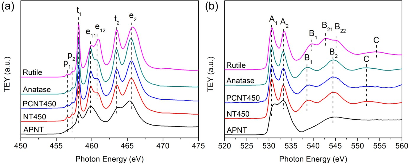
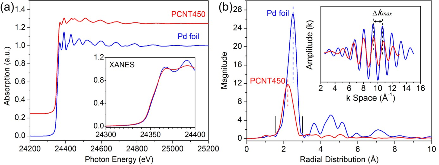
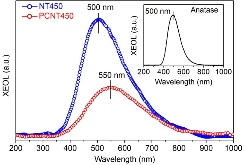
The electronic structure and optical properties of Pd-modified TiO2 nanotubes (NTs) with a vertically aligned nanotubular structure grown by a two-step electrochemical anodization method have been studied using X-ray spectroscopy. X-ray absorption near-edge structure (XANES) at the Ti L3,2- and O K-edges was used to investigate the TiO2 NTs before and after Pd modification. It was found that Pd nanoparticles (NPs) are uniformly coated on the NT surface. The Pd L3-edge of the deposited Pd NPs shows a more intense whiteline and a blue shift for the Pd L3-edge absorption threshold relative to Pd metal, indicating charge depletion from the Pd 4d orbital as a result NP formation. The lattice of Pd is slightly contracted upon NP formation, although it remains fcc as revealed by extended X-ray absorption fine structure (EXAFS) analysis at the Pd K-edge. X-ray-excited optical luminescence (XEOL) together with XANES with element and site specificity was used to study the optical luminescence from TiO2 NTs. It was found that the defect-originated XEOL intensity dropped noticeably in the Pd NP-coated NTs, suggesting a Pd NP–TiO2-interaction-mediated reduction in the radiative recombination of electrons and holes. Finally, further evidence is provided by Ti 2p resonant inelastic X-ray scattering (RIXS), in which no low-energy loss features (d–d transitions) were observed. The implications of these results are discussed.
- Research Organization:
- Lawrence Berkeley National Laboratory (LBNL), Berkeley, CA (United States)
- Sponsoring Organization:
- USDOE Office of Science (SC), Basic Energy Sciences (BES) (SC-22)
- Grant/Contract Number:
- AC02-05CH11231
- OSTI ID:
- 1512161
- Journal Information:
- Journal of Physical Chemistry. C, Journal Name: Journal of Physical Chemistry. C Journal Issue: 4 Vol. 119; ISSN 1932-7447
- Publisher:
- American Chemical SocietyCopyright Statement
- Country of Publication:
- United States
- Language:
- English
A facile route for the synthesis of heterogeneous crystal structures in hierarchical architectures with vacancy-driven defects via the oriented attachment growth mechanism
|
journal | January 2018 |
Tailored fabrication of iridium nanoparticle-sensitized titanium oxynitride nanotubes for solar-driven water splitting: experimental insights on the photocatalytic–activity–defects relationship
|
journal | January 2020 |
Synergetic effect on catalytic activity and charge transfer in Pt-Pd bimetallic model catalysts prepared by atomic layer deposition
|
journal | January 2020 |


Similar Records
Optical emission of biaxial ZnO-ZnS nanoribbon heterostructures
RIXS, XEOL and XEOL Imaging of Rare-earth Phosphors at the L3,2-edges
Solvation Structure of 237Np4+ in a Noncomplexing Environment
Journal Article
·
Fri Feb 27 04:00:00 UTC 2009
· Journal of Chemical Physics
·
OSTI ID:1005528
RIXS, XEOL and XEOL Imaging of Rare-earth Phosphors at the L3,2-edges
Conference
·
Mon Jul 19 04:00:00 UTC 2010
·
OSTI ID:1009072
Solvation Structure of 237Np4+ in a Noncomplexing Environment
Journal Article
·
Tue Sep 09 00:00:00 UTC 2025
· Inorganic Chemistry
·
OSTI ID:3005006