High thermoelectric performance in (Bi0.25Sb0.75)2Te3 due to band convergence and improved by carrier concentration control
Journal Article
·
· Materials Today
- Northwestern Univ., Evanston, IL (United States); California Inst. of Technology (CalTech), Pasadena, CA (United States); Samsung Advanced Institute of Technology, Samsung Electronics (South Korea)
- California Inst. of Technology (CalTech), Pasadena, CA (United States)
- Northwestern Univ., Evanston, IL (United States); California Inst. of Technology (CalTech), Pasadena, CA (United States)
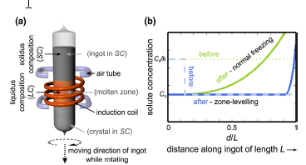
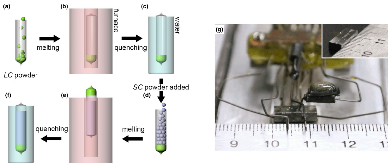
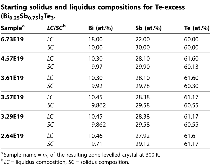
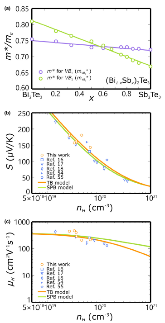
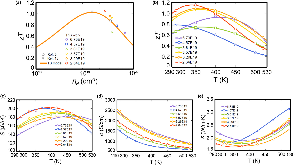
Bi2Te3 has been recognized as an important cooling material for thermoelectric applications. Yet its thermoelectric performance could still be improved. Here we propose a band engineering strategy by optimizing the converging valence bands of Bi2Te3 and Sb2Te3 in the (Bi1-xSbx)2Te3 system when x = 0.75. Band convergence successfully explains the sharp increase in density-of-states effective mass yet relatively constant mobility and optical band gap measurement. This band convergence picture guides the carrier concentration tuning for optimum thermoelectric performance. To synthesize homogeneous textured and optimally doped (Bi0.25Sb0.75)2Te3, excess Te was chosen as the dopant. Uniform control of the optimized thermoelectric composition was achieved by zone-melting which utilizes separate solidus and liquidus compositions to obtain zT = 1.05 (at 300 K) without nanostructuring.
- Research Organization:
- Massachusetts Inst. of Technology, Cambridge, MA (United States); Energy Frontier Research Centers (EFRC) (United States). Solid-State Solar-Thermal Energy Conversion Center (S3TEC)
- Sponsoring Organization:
- USDOE Office of Science (SC), Basic Energy Sciences (BES) (SC-22)
- Grant/Contract Number:
- SC0001299
- OSTI ID:
- 1470452
- Journal Information:
- Materials Today, Journal Name: Materials Today Journal Issue: 8 Vol. 20; ISSN 1369-7021
- Publisher:
- ElsevierCopyright Statement
- Country of Publication:
- United States
- Language:
- English

Similar Records
Thermoelectric properties of Bi{sub 2}Te{sub 3}, Sb{sub 2}Te{sub 3} and Bi{sub 2}Se{sub 3} single crystals with magnetic impurities
Thermoelectric properties of p-type pseudo-binary (Ag{sub 0.365}Sb{sub 0.558}Te) {sub x} -(Bi{sub 0.5}Sb{sub 1.5}Te{sub 3}){sub 1-} {sub x} (x=0-1.0) alloys prepared by spark plasma sintering
Journal Article
·
Sat Sep 15 00:00:00 EDT 2012
· Journal of Solid State Chemistry
·
OSTI ID:22149799
Thermoelectric properties of p-type pseudo-binary (Ag{sub 0.365}Sb{sub 0.558}Te) {sub x} -(Bi{sub 0.5}Sb{sub 1.5}Te{sub 3}){sub 1-} {sub x} (x=0-1.0) alloys prepared by spark plasma sintering
Journal Article
·
Thu Dec 14 23:00:00 EST 2006
· Journal of Solid State Chemistry
·
OSTI ID:20900915
Related Subjects
36 MATERIALS SCIENCE
42 ENGINEERING
charge transport
defects
materials and chemistry by design
mechanical behavior
optics
phonons
solar (photovoltaic)
solar (thermal)
solid state lighting
spin dynamics
synthesis (novel materials)
synthesis (scalable processing)
synthesis (self-assembly)
thermal conductivity
thermoelectric
42 ENGINEERING
charge transport
defects
materials and chemistry by design
mechanical behavior
optics
phonons
solar (photovoltaic)
solar (thermal)
solid state lighting
spin dynamics
synthesis (novel materials)
synthesis (scalable processing)
synthesis (self-assembly)
thermal conductivity
thermoelectric