The complex physiology of Cellvibrio japonicus xylan degradation relies on a single cytoplasmic β-xylosidase for xylo-oligosaccharide utilization
- Univ. of Maryland Baltimore County (UMBC), Baltimore, MD (United States). Dept. of Biological Sciences; University of Maryland - Baltimore County
- Univ. of Maryland Baltimore County (UMBC), Baltimore, MD (United States). Dept. of Biological Sciences
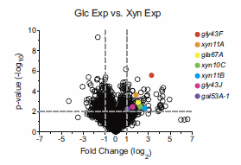
Lignocellulose degradation by microbes plays a central role in global carbon cycling, human gut metabolism, and renewable energy technologies. While considerable effort has been put into understanding the biochemical aspects of lignocellulose degradation, much less work has been done to understand how these enzymes work in an in vivo context. Here in this paper, we report a systems level study of xylan degradation in the saprophytic bacterium Cellvibrio japonicus. Transcriptome analysis indicated seven genes that encode carbohydrate active enzymes were up-regulated during growth with xylan containing media. In-frame deletion analysis of these genes found that only gly43F is critical for utilization of xylo-oligosaccharides, xylan, and arabinoxylan. Heterologous expression of gly43F was sufficient for the utilization of xylo-oligosaccharides in Escherichia coli. Additional analysis found that the xyn11A, xyn11B, abf43L, abf43K, and abf51A gene products were critical for utilization of arabinoxylan. Furthermore, a predicted transporter (CJA_1315) was required for effective utilization of xylan substrates, and we propose this unannotated gene be called xntA (xylan transporter A). Our major findings are 1) C. japonicus employs both secreted and surface associated enzymes for xylan degradation, which differs from the strategy used for cellulose degradation, and 2) a single cytoplasmic β-xylosidase is essential for the utilization of xylo-oligosaccharides.
- Research Organization:
- Univ. of Maryland Baltimore County (UMBC), Baltimore, MD (United States)
- Sponsoring Organization:
- USDOE; USDOE Office of Science (SC), Biological and Environmental Research (BER) (SC-23). Biological Systems Science Division
- Grant/Contract Number:
- SC0014183
- OSTI ID:
- 1415270
- Alternate ID(s):
- OSTI ID: 1416401
- Journal Information:
- Molecular Microbiology, Journal Name: Molecular Microbiology Journal Issue: 5 Vol. 107; ISSN 0950-382X
- Publisher:
- WileyCopyright Statement
- Country of Publication:
- United States
- Language:
- English
High-throughput screening of environmental polysaccharide-degrading bacteria using biomass containment and complex insoluble substrates
|
journal | February 2020 |
Systems analysis of the glycoside hydrolase family 18 enzymes from Cellvibrio japonicus characterizes essential chitin degradation functions
|
journal | January 2018 |
Two forms of phosphomannomutase in gammaproteobacteria: The overlooked membrane‐bound form of AlgC is required for twitching motility of Lysobacter enzymogenes
|
journal | May 2019 |
Complete Genome Sequences of Cellvibrio japonicus Strains with Improved Growth When Using α-Diglucosides
|
journal | October 2019 |


Similar Records
Polysaccharide degradation systems of the saprophytic bacterium Cellvibrio japonicus
Efficient chito–oligosaccharide utilization requires two TonB–dependent transporters and one hexosaminidase in Cellvibrio japonicus
Journal Article
·
Fri Jun 03 20:00:00 EDT 2016
· World Journal of Microbiology and Biotechnology
·
OSTI ID:1259846
Efficient chito–oligosaccharide utilization requires two TonB–dependent transporters and one hexosaminidase in Cellvibrio japonicus
Journal Article
·
Wed Mar 17 20:00:00 EDT 2021
· Molecular Microbiology
·
OSTI ID:1774542