Computational Redesign of Acyl-ACP Thioesterase with Improved Selectivity toward Medium-Chain-Length Fatty Acids
- Pennsylvania State Univ., University Park, PA (United States). Dept. of Chemical Engineering; Department of Chemical Engineering, Pennsylvania State University
- Univ. of Wisconsin, Madison, WI (United States). Dept. of Chemical and Biological Engineering
- Univ. of Wisconsin, Madison, WI (United States). Dept. of Biochemistry
- Pennsylvania State Univ., University Park, PA (United States). Dept. of Chemical Engineering
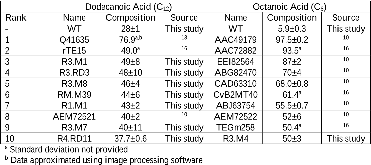
Enzyme and metabolic engineering offer the potential to develop biocatalysts for converting natural resources to a wide range of chemicals. To broaden the scope of potential products beyond natural metabolites, methods of engineering enzymes to accept alternative substrates and/or perform novel chemistries must be developed. DNA synthesis can create large libraries of enzyme-coding sequences, but most biochemistries lack a simple assay to screen for promising enzyme variants. Our solution to this challenge is structure-guided mutagenesis, in which optimization algorithms select the best sequences from libraries based on specified criteria (i.e., binding selectivity). We demonstrate this approach by identifying medium-chain (C8–C12) acyl-ACP thioesterases through structure-guided mutagenesis. Medium-chain fatty acids, which are products of thioesterase-catalyzed hydrolysis, are limited in natural abundance, compared to long-chain fatty acids; the limited supply leads to high costs of C6–C10 oleochemicals such as fatty alcohols, amines, and esters. Here, we applied computational tools to tune substrate binding of the highly active ‘TesA thioesterase in Escherichia coli. We used the IPRO algorithm to design thioesterase variants with enhanced C12 or C8 specificity, while maintaining high activity. After four rounds of structure-guided mutagenesis, we identified 3 variants with enhanced production of dodecanoic acid (C12) and 27 variants with enhanced production of octanoic acid (C8). The top variants reached up to 49% C12 and 50% C8 while exceeding native levels of total free fatty acids. A comparably sized library created by random mutagenesis failed to identify promising mutants. The chain length-preference of ‘TesA and the best mutant were confirmed in vitro using acyl-CoA substrates. Molecular dynamics simulations, confirmed by resolved crystal structures, of ‘TesA variants suggest that hydrophobic forces govern ‘TesA substrate specificity. Finally, we expect the design rules that we uncovered and the thioesterase variants that we identified will be useful to metabolic engineering projects aimed at sustainable production of medium-chain-length oleochemicals.
- Research Organization:
- Pennsylvania State Univ., University Park, PA (United States)
- Sponsoring Organization:
- National Institutes of Health (NIH); USDOE Advanced Research Projects Agency - Energy (ARPA-E)
- Grant/Contract Number:
- AR0000432
- OSTI ID:
- 1408279
- Journal Information:
- ACS Catalysis, Journal Name: ACS Catalysis Journal Issue: 6 Vol. 7; ISSN 2155-5435
- Publisher:
- American Chemical Society (ACS)Copyright Statement
- Country of Publication:
- United States
- Language:
- English




Similar Records
Data for "Metabolic Engineering Strategies to Produce Medium-Chain Oleochemicals via Acyl-ACP:CoA Transacylase Activity"
Data for "Metabolic Engineering Strategies to Produce Medium-Chain Oleochemicals via Acyl-ACP:CoA Transacylase Activity"
Dataset
·
Wed Feb 23 19:00:00 EST 2022
·
OSTI ID:3015970
Data for "Metabolic Engineering Strategies to Produce Medium-Chain Oleochemicals via Acyl-ACP:CoA Transacylase Activity"
Dataset
·
Sun Jan 11 19:00:00 EST 2026
·
OSTI ID:3013397