
Spatial and Temporal Variations in the Moment Tensor Solutions of the 2008 Wenchuan Earthquake Aftershocks and Their Tectonic Implications
Abstract
Following the mainshock of the 2008 M8 Wenchuan Earthquake, there were more than 300 ML ≥ 4.0 aftershocks that occurred between 12 May 2008 and 8 September 2010. We analyzed here the broadband waveforms for these events and found 160 events with sufficient signal-to-noise levels to invert for seismic moment tensors. Considering the length of the activated fault and the distances to the recording stations, four velocity models were employed to account for variability in crustal structure. The moment tensor solutions show considerable variations with a mixture of mainly reverse and strike-slip mechanisms and a small number of normal events and ambiguous events. We analyzed the spatial and temporal distribution of the aftershocks and their mechanism types to characterize the structure and the deformation occurring in the Longmen Shan fold and thrust belt. Our results suggest that the stress is very complex at the Longmen Shan fault zone. The moment tensors have both a spatial segmentation with two major categories of the moment tensor of thrust and strike slip; and a temporal pattern that the majority of the aftershocks gradually migrated to thrust-type events. The variability of aftershock mechanisms is a strong indication of significant tectonic release and stress reorganizationmore »
- Authors:
-
 [1];
[4];
[5]
[1];
[4];
[5]
- Beijing Earthquake Agency (China)
- Univ. of California, Berkeley, CA (United States). Berkeley Seismological Lab.
- China Univ. of Petroleum, Beijing (China). Unconventional Natural Gas Inst.
- Lawrence Livermore National Lab. (LLNL), Livermore, CA (United States)
- Macquarie Univ., North Ryde, NSW (Australia). ARC Centre of Excellence from Core to Crust Fluid Systems; Univ. of Western Australia, Perth, WA (Australia). Centre for Exploration Targeting; Geological Survey of Western Australia, East Perth, WA (Australia)
- Publication Date:
- Research Org.:
- Lawrence Livermore National Lab. (LLNL), Livermore, CA (United States); Beijing Earthquake Agency (China); China Univ. of Petroleum, Beijing (China)
- Sponsoring Org.:
- USDOE; National Natural Science Foundation of China (NSFC); China Earthquake Administration (CEA); China Scholarship Council
- OSTI Identifier:
- 1513154
- Report Number(s):
- LLNL-JRNL-771048
Journal ID: ISSN 0278-7407; 960868
- Grant/Contract Number:
- AC52-07NA27344; 41604045; 41474087; XH16004Y
- Resource Type:
- Accepted Manuscript
- Journal Name:
- Tectonics
- Additional Journal Information:
- Journal Volume: 37; Journal Issue: 3; Journal ID: ISSN 0278-7407
- Publisher:
- Wiley/American Geophysical Union (AGU)
- Country of Publication:
- United States
- Language:
- English
- Subject:
- 58 GEOSCIENCES; aftershock sequence; moment tensor solution; broadband waveforms; Wenchuan earthquake
Citation Formats
                    Lin, X., Dreger, D., Ge, H., Xu, P., Wu, M., Chiang, A., Zhao, G., and Yuan, H. Spatial and Temporal Variations in the Moment Tensor Solutions of the 2008 Wenchuan Earthquake Aftershocks and Their Tectonic Implications.  United States: N. p., 2018.
Web.  doi:10.1002/2017TC004764.
Lin, X., Dreger, D., Ge, H., Xu, P., Wu, M., Chiang, A., Zhao, G., & Yuan, H. Spatial and Temporal Variations in the Moment Tensor Solutions of the 2008 Wenchuan Earthquake Aftershocks and Their Tectonic Implications. United States. https://doi.org/10.1002/2017TC004764
                    Lin, X., Dreger, D., Ge, H., Xu, P., Wu, M., Chiang, A., Zhao, G., and Yuan, H. Sat .
"Spatial and Temporal Variations in the Moment Tensor Solutions of the 2008 Wenchuan Earthquake Aftershocks and Their Tectonic Implications".  United States.  https://doi.org/10.1002/2017TC004764.  https://www.osti.gov/servlets/purl/1513154.
@article{osti_1513154,

  title        = {Spatial and Temporal Variations in the Moment Tensor Solutions of the 2008 Wenchuan Earthquake Aftershocks and Their Tectonic Implications},

  author       = {Lin, X. and Dreger, D. and Ge, H. and Xu, P. and Wu, M. and Chiang, A. and Zhao, G. and Yuan, H.},

  abstractNote = {Following the mainshock of the 2008 M8 Wenchuan Earthquake, there were more than 300 ML ≥ 4.0 aftershocks that occurred between 12 May 2008 and 8 September 2010. We analyzed here the broadband waveforms for these events and found 160 events with sufficient signal-to-noise levels to invert for seismic moment tensors. Considering the length of the activated fault and the distances to the recording stations, four velocity models were employed to account for variability in crustal structure. The moment tensor solutions show considerable variations with a mixture of mainly reverse and strike-slip mechanisms and a small number of normal events and ambiguous events. We analyzed the spatial and temporal distribution of the aftershocks and their mechanism types to characterize the structure and the deformation occurring in the Longmen Shan fold and thrust belt. Our results suggest that the stress is very complex at the Longmen Shan fault zone. The moment tensors have both a spatial segmentation with two major categories of the moment tensor of thrust and strike slip; and a temporal pattern that the majority of the aftershocks gradually migrated to thrust-type events. The variability of aftershock mechanisms is a strong indication of significant tectonic release and stress reorganization that activated numerous small faults in the system.},

  doi          = {10.1002/2017TC004764},

  journal      = {Tectonics},

  number       = 3,

  volume       = 37,

  place        = {United States},

  year         = {Sat Mar 10 00:00:00 EST 2018},

  month        = {Sat Mar 10 00:00:00 EST 2018}

}
 Search WorldCat to find libraries that may hold this journal
Web of Science
Figures / Tables:
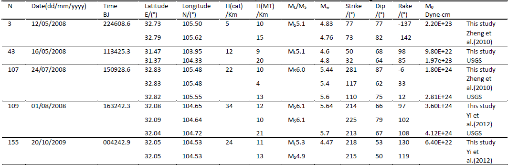 Table 1: Comparison of Wenchuan aftershock moment tensor results. H(cat) is the source depth from the China National Seismic Network, CEA. H(MT) is the modeled source depth from inversion.
Works referenced in this record:
Kinematic fault slip evolution source models of the 2008 M7.9 Wenchuan earthquake in China from SAR interferometry, GPS and teleseismic analysis and implications for Longmen Shan tectonics
journal, May 2013
- Fielding, Eric J.; Sladen, Anthony; Li, Zhenhong
- Geophysical Journal International, Vol. 194, Issue 2
Regional stresses inferred from coseismic slip models of the 2008 Mw 7.9 Wenchuan, China, earthquake
journal, January 2013
- Medina Luna, Lorena; Hetland, Eric A.
- Tectonophysics, Vol. 584
Surface wave array tomography in SE Tibet from ambient seismic noise and two-station analysis - II. Crustal and upper-mantle structure
journal, April 2008
- Yao, Huajian; Beghein, Caroline; van der Hilst, Robert D.
- Geophysical Journal International, Vol. 173, Issue 1
Source Parameters of the 2014 M s 6.5 Ludian Earthquake Sequence and Their Implications on the Seismogenic Structure
journal, September 2015
- Xie, Zujun; Zheng, Yong; Liu, Chengli
- Seismological Research Letters, Vol. 86, Issue 6
The role of crustal strength variations in shaping orogenic plateaus, with application to Tibet: CRUSTAL STRENGTH AND PLATEAU DEFORMATION
journal, August 2008
- Cook, Kristen L.; Royden, Leigh H.
- Journal of Geophysical Research: Solid Earth, Vol. 113, Issue B8
Non-double-couple earthquakes 1. Theory
journal, November 1998
- Julian, Bruce R.; Miller, Angus D.; Foulger, G. R.
- Reviews of Geophysics, Vol. 36, Issue 4
Lithospheric structure of the Arabian Shield and Platform from complete regional waveform modelling and surface wave group velocities
journal, September 1999
- Rodgers, Arthur J.; Walter, William R.; Mellors, Robert J.
- Geophysical Journal International, Vol. 138, Issue 3
Parametrization of general seismic potency and moment tensors for source inversion of seismic waveform data
journal, April 2013
- Zhu, Lupei; Ben-Zion, Yehuda
- Geophysical Journal International, Vol. 194, Issue 2
Slip maxima at fault junctions and rupturing of barriers during the 2008 Wenchuan earthquake
journal, September 2009
- Shen, Zheng-Kang; Sun, Jianbao; Zhang, Peizhen
- Nature Geoscience, Vol. 2, Issue 10
Crustal structure beneath the eastern margin of the Tibetan Plateau and its tectonic implications
journal, January 2007
- Wang, Chun-Yong; Han, Wei-Bin; Wu, Jian-Ping
- Journal of Geophysical Research, Vol. 112, Issue B7
Continuous Permeability Measurements Record Healing Inside the Wenchuan Earthquake Fault Zone
journal, June 2013
- Xue, Lian; Li, Hai-Bing; Brodsky, Emily E.
- Science, Vol. 340, Issue 6140
Source parameters of the Sierra Madre Earthquake from regional and local body waves
journal, November 1991
- Dreger, Douglas; Helmberger, Donald
- Geophysical Research Letters, Vol. 18, Issue 11
The Role Played and Opportunities Provided by IGP DMC of China National Seismic Network in Wenchuan Earthquake Disaster Relief and Researches
journal, October 2010
- Zheng, X. -F.; Yao, Z. -X.; Liang, J. -H.
- Bulletin of the Seismological Society of America, Vol. 100, Issue 5B
Two-phase growth of high topography in eastern Tibet during the Cenozoic
journal, August 2012
- Wang, E.; Kirby, E.; Furlong, K. P.
- Nature Geoscience, Vol. 5, Issue 9
Spatial distribution and focal mechanism solutions of the Wenchuan earthquake series: Results and implications
journal, February 2011
- Cai, Chen; Yu, Chunquan; Tao, Kai
- Earthquake Science, Vol. 24, Issue 1
Seismic signature of the collision between the east Tibetan escape flow and the Sichuan Basin
journal, April 2010
- Zhang, Zhongjie; Yuan, Xiaohui; Chen, Yun
- Earth and Planetary Science Letters, Vol. 292, Issue 3-4
12 May 2008 M = 7.9 Wenchuan, China, earthquake calculated to increase failure stress and seismicity rate on three major fault systems
journal, January 2008
- Toda, Shinji; Lin, Jian; Meghraoui, Mustapha
- Geophysical Research Letters, Vol. 35, Issue 17
Dilational Processes Accompanying Earthquakes in the Long Valley Caldera
journal, April 2000
- Dreger, D. S.
- Science, Vol. 288, Issue 5463
Stress changes from the 2008 Wenchuan earthquake and increased hazard in the Sichuan basin
journal, July 2008
- Parsons, Tom; Ji, Chen; Kirby, Eric
- Nature, Vol. 454, Issue 7203
Surface Deformation and Lower Crustal Flow in Eastern Tibet
journal, May 1997
- Royden, L. H.
- Science, Vol. 276, Issue 5313
Coseismic slip model of the 2008 Wenchuan earthquake derived from joint inversion of interferometric synthetic aperture radar, GPS, and field data
journal, January 2010
- Tong, Xiaopeng; Sandwell, David T.; Fialko, Yuri
- Journal of Geophysical Research, Vol. 115, Issue B4
Rupture of deep faults in the 2008 Wenchuan earthquake and uplift of the Longmen Shan
journal, July 2011
- Qi, Wang; Xuejun, Qiao; Qigui, Lan
- Nature Geoscience, Vol. 4, Issue 9
Oblique, High-Angle, Listric-Reverse Faulting and Associated Development of Strain: The Wenchuan Earthquake of May 12, 2008, Sichuan, China
journal, April 2010
- Zhang, Pei-Zhen; Wen, Xue-ze; Shen, Zheng-Kang
- Annual Review of Earth and Planetary Sciences, Vol. 38, Issue 1
Spatial segmentation characteristic of focal mechanism of aftershock sequence of Wenchuan Earthquake
journal, June 2009
- Wang, QinCai; Chen, ZhangLi; Zheng, SiHua
- Chinese Science Bulletin, Vol. 54, Issue 13
Co-seismic thrusting rupture and slip distribution produced by the 2008 Mw 7.9 Wenchuan earthquake, China
journal, June 2009
- Lin, Aiming; Ren, Zhikun; Jia, Dong
- Tectonophysics, Vol. 471, Issue 3-4
First- and second-order patterns of stress in the lithosphere: The World Stress Map Project
journal, January 1992
- Zoback, Mary Lou
- Journal of Geophysical Research, Vol. 97, Issue B8
A Preliminary Study on Crustal Velocity Structures of Maqin-Lanzhou-Jingbian Deep Seismic Sounding Profile
journal, March 2002
- Li, Song-Lin; Zhang, Xian-Kang; Zhang, Cheng-Ke
- Chinese Journal of Geophysics, Vol. 45, Issue 2
Stable inversions for complete moment tensors
journal, August 2008
- Minson, Sarah E.; Dreger, Douglas S.
- Geophysical Journal International, Vol. 174, Issue 2
Rupture process of the 2008 Wenchuan, China earthquake inferred from teleseismic waveform inversion and forward modeling of broadband seismic waves
journal, August 2010
- Nakamura, Takeshi; Tsuboi, Seiji; Kaneda, Yoshiyuki
- Tectonophysics, Vol. 491, Issue 1-4
A geological and geophysical context for the Wenchuan earthquake of 12 May 2008, Sichuan, People's Republic of China
journal, January 2008
- Burchfiel, B. C.; Royden, L. H.; van der Hilst, R. D.
- GSA Today, Vol. 18, Issue 7
Slip distribution of the 2008 Wenchuan Ms 7.9 earthquake by joint inversion from GPS and InSAR measurements: a resolution test study: Slip distribution of 2008 Wenchuan earthquake
journal, May 2011
- Zhang, Guohong; Qu, Chunyan; Shan, Xinjian
- Geophysical Journal International, Vol. 186, Issue 1
Rupture process of the Wenchuan M8.0 earthquake of Sichuan China: the segmentation feature
journal, August 2009
- Zhao, CuiPing; Chen, ZhangLi; Zhou, LianQing
- Chinese Science Bulletin, Vol. 55, Issue 3
Coseismic fault slip of the 2008 M w 7.9 Wenchuan earthquake estimated from InSAR and GPS measurements : WENCHUAN COSEISMIC FAULT SLIP
journal, January 2010
- Feng, GuangCai; Hetland, Eric A.; Ding, XiaoLi
- Geophysical Research Letters, Vol. 37, Issue 1
Component azimuths of the CEArray stations estimated from P-wave particle motion
journal, February 2011
- Niu, Fenglin; Li, Juan
- Earthquake Science, Vol. 24, Issue 1
Failure patterns caused by localized rise in pore-fluid overpressure and effective strength of rocks
journal, January 2007
- Rozhko, A. Y.; Podladchikov, Y. Y.; Renard, F.
- Geophysical Research Letters, Vol. 34, Issue 22
Strong Ground-Motion Simulation of the 12 May 2008 Mw 7.9 Wenchuan Earthquake, Using Various Slip Models
journal, October 2010
- Bjerrum, L. W.; Sorensen, M. B.; Atakan, K.
- Bulletin of the Seismological Society of America, Vol. 100, Issue 5B
Source process of the 12 May 2008 Wenchuan, China, earthquake determined by waveform inversion of teleseismic body waves with a data covariance matrix
journal, July 2012
- Yagi, Yuji; Nishimura, Naoki; Kasahara, Amato
- Earth, Planets and Space, Vol. 64, Issue 7
Study on the Effect of Source-Contacting Gas Accumulations upon Abnormal Pressures in Western Sichuan Depression
journal, March 2008
- Zhang, Jinchuan; Liu, Lifang; Tang, Xuan
- Earth Science Frontiers, Vol. 15, Issue 2
The 1994 Northridge earthquake sequence in California: Seismological and tectonic aspects
journal, July 1995
- Hauksson, Egill; Jones, Lucile M.; Hutton, Kate
- Journal of Geophysical Research: Solid Earth, Vol. 100, Issue B7
Crustal Structures beneath West Qinling-East Kunlun Orogen and its Adjacent Area -Result of Wide-Angle Seismic Reflection and Refraction Experiment
journal, March 2008
- Zhang, Xian-Kang; Jia, Shi-Xu; Zhao, Jin-Ren
- Chinese Journal of Geophysics, Vol. 51, Issue 2
Crustal thicknesses and Poisson's ratios in the eastern Tibetan Plateau and their tectonic implications
journal, January 2010
- Wang, Chun-Yong; Zhu, Lupei; Lou, Hai
- Journal of Geophysical Research, Vol. 115, Issue B11
Structure of the crust beneath the southeastern Tibetan Plateau from teleseismic receiver functions
journal, December 2007
- Xu, Lili; Rondenay, Stéphane; van der Hilst, Robert D.
- Physics of the Earth and Planetary Interiors, Vol. 165, Issue 3-4
Strong aftershocks in the northern segment of the Wenchuan earthquake rupture zone and their seismotectonic implications
journal, November 2010
- Zheng, Yong; Ni, Sidao; Xie, Zujun
- Earth, Planets and Space, Vol. 62, Issue 11
Determination of source parameters at regional distances with three-component sparse network data
journal, May 1993
- Dreger, Douglas S.; Helmberger, Donald V.
- Journal of Geophysical Research: Solid Earth, Vol. 98, Issue B5
Isotropic source terms of San Jacinto fault zone earthquakes based on waveform inversions with a generalized CAP method
journal, January 2015
- Ross, Z. E.; Ben-Zion, Y.; Zhu, L.
- Geophysical Journal International, Vol. 200, Issue 2
Surface wave array tomography in SE Tibet from ambient seismic noise and two-station analysis - II. Crustal and upper-mantle structure
text, January 2017
- Yao, Huajian; Beghein, Caroline; van der Hilst, Robert
- EarthArXiv
Works referencing / citing this record:
A Gravity Study of the Longmenshan Fault Zone: New Insights Into the Nature and Evolution of the Fault Zone and Extrusion-Style Growth of the Tibetan Plateau Since 40 Ma
journal, January 2019
- Jiang, Xiaodian; Li, Zheng-Xiang; Li, Chaoyang
- Tectonics, Vol. 38, Issue 1
Figures / Tables found in this record: