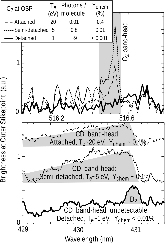
Unique diagnostic and access features of the DIII-D tokamak, including a sample exposure system, have been used to carry out controlled and well-diagnosed plasma-surface interactions (PSI) experiments. An important contribution of the experiments has been the ability to link a given plasma exposure condition to a measured response of the plasma-facing surface and to thus understand the interaction. This has allowed for benchmarking certain aspects of erosion models, particularly near-surface particle transport. DIII-D has empirically quantified some of the PSI effects that will limit the operation availability and lifetime of future fusion devices, namely, net erosion limiting divertor plate lifetime and hydrogenic fuel retention in deposit layers. Cold divertor plasmas obtained with detachment can suppress net carbon divertor erosion, but many low-temperature divertor PSI phenomena remain poorly understood: nondivertor erosion sources, long-range particle transport, global erosion/deposition patterns, the enhancement of carbon erosion with neon impurity seeding, the sputtered carbon velocity distribution, and the apparent suppression of carbon chemical erosion in detachment. Long-term particle and energy fluences have reduced the chemical erosion yield of lower-divertor tiles. Finally, plasma-caused modification of a material’s erosion properties, including material mixing, will occur quickly and be important in long-pulse fusion devices, making prediction of PSI difficult in future devices.
Whyte, D. G.. "Plasma-Surface Interaction Studies on DIII-D and Their Implications for Next-Step Fusion Experiments." Fusion Science and Technology, vol. 48, no. 2, Apr. 2017. https://doi.org/10.13182/fst05-a1063
Whyte, D. G. (2017). Plasma-Surface Interaction Studies on DIII-D and Their Implications for Next-Step Fusion Experiments. Fusion Science and Technology, 48(2). https://doi.org/10.13182/fst05-a1063
Whyte, D. G., "Plasma-Surface Interaction Studies on DIII-D and Their Implications for Next-Step Fusion Experiments," Fusion Science and Technology 48, no. 2 (2017), https://doi.org/10.13182/fst05-a1063
@article{osti_837299,
  author       = {Whyte, D. G.},
  title        = {Plasma-Surface Interaction Studies on DIII-D and Their Implications for Next-Step Fusion Experiments},
  annote       = {Unique diagnostic and access features of the DIII-D tokamak, including a sample exposure system, have been used to carry out controlled and well-diagnosed plasma-surface interactions (PSI) experiments. An important contribution of the experiments has been the ability to link a given plasma exposure condition to a measured response of the plasma-facing surface and to thus understand the interaction. This has allowed for benchmarking certain aspects of erosion models, particularly near-surface particle transport. DIII-D has empirically quantified some of the PSI effects that will limit the operation availability and lifetime of future fusion devices, namely, net erosion limiting divertor plate lifetime and hydrogenic fuel retention in deposit layers. Cold divertor plasmas obtained with detachment can suppress net carbon divertor erosion, but many low-temperature divertor PSI phenomena remain poorly understood: nondivertor erosion sources, long-range particle transport, global erosion/deposition patterns, the enhancement of carbon erosion with neon impurity seeding, the sputtered carbon velocity distribution, and the apparent suppression of carbon chemical erosion in detachment. Long-term particle and energy fluences have reduced the chemical erosion yield of lower-divertor tiles. Finally, plasma-caused modification of a material’s erosion properties, including material mixing, will occur quickly and be important in long-pulse fusion devices, making prediction of PSI difficult in future devices.},
  doi          = {10.13182/fst05-a1063},
  url          = {https://www.osti.gov/biblio/837299},
  journal      = {Fusion Science and Technology},
  issn         = {ISSN 1536-1055},
  number       = {2},
  volume       = {48},
  place        = {United States},
  publisher    = {Taylor & Francis},
  year         = {2017},
  month        = {04}}