Two-dimensional-lattice-confined single-molecule-like aggregates
- Purdue University, West Lafayette, IN (United States); Chinese Academy of Sciences, Beijing (China)
- Purdue University, West Lafayette, IN (United States)
- Yale University, New Haven, CT (United States); Yale University, West Haven, CT (United States)
- Chinese Academy of Sciences, Beijing (China)
- Lawrence Berkeley National Laboratory (LBNL), Berkeley, CA (United States)
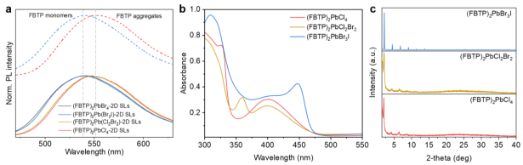
Intermolecular distance largely determines the optoelectronic properties of organic matter. Conventional organic luminescent molecules are commonly used either as aggregates or as single molecules that are diluted in a foreigner matrix. They have garnered great research interest in recent decades for a variety of applications, including light-emitting diodes, lasers and quantum technologies, among others. However, there is still a knowledge gap on how these molecules behave between the aggregation and dilution states. Here we report an unprecedented phase of molecular aggregate that forms in a two-dimensional hybrid perovskite superlattice with a near-equilibrium distance, which we refer to as a single-molecule-like aggregate (SMA). By implementing two-dimensional superlattices, the organic emitters are held in proximity, but, surprisingly, remain electronically isolated, thereby resulting in a near-unity photoluminescence quantum yield, akin to that of single molecules. Moreover, the emitters within the perovskite superlattices demonstrate strong alignment and dense packing resembling aggregates, allowing for the observation of robust directional emission, substantially enhanced radiative recombination and efficient lasing. Molecular dynamics simulations together with single-crystal structure analysis emphasize the critical role of the internal rotational and vibrational degrees of freedom of the molecules in the two-dimensional lattice for creating the exclusive SMA phase. Furthermore, this two-dimensional superlattice unifies the paradoxical properties of single molecules and aggregates, thus offering exciting possibilities for advanced spectroscopic and photonic applications.
- Research Organization:
- Purdue University, West Lafayette, IN (United States)
- Sponsoring Organization:
- Air Force Office of Scientific Research (AFOSR); National Science Foundation (NSF); Office of Naval Research (ONR); USDOE Office of Energy Efficiency and Renewable Energy (EERE), Renewable Power Office. Solar Energy Technologies Office; USDOE Office of Science (SC), Basic Energy Sciences (BES)
- Grant/Contract Number:
- EE0009519
- OSTI ID:
- 2474941
- Journal Information:
- Nature (London), Journal Name: Nature (London) Journal Issue: 8030 Vol. 633; ISSN 0028-0836
- Publisher:
- Nature Publishing GroupCopyright Statement
- Country of Publication:
- United States
- Language:
- English


Similar Records
A Perturbative Solution for Nonlinear Stratified Upwelling over a Frictional Slope
Emerging Two-Dimensional Organic Semiconductor-Incorporated Perovskites–A Fascinating Family of Hybrid Electronic Materials
Journal Article
·
Sun Oct 01 04:00:00 UTC 2023
· Journal of Physical Oceanography
·
OSTI ID:2580152
Emerging Two-Dimensional Organic Semiconductor-Incorporated Perovskites–A Fascinating Family of Hybrid Electronic Materials
Journal Article
·
Thu Sep 14 00:00:00 UTC 2023
· Journal of the American Chemical Society
·
OSTI ID:2203277