Crosstalk Effects in Microwave SQUID Multiplexed TES Bolometer Readout
Journal Article
·
· Journal of Low Temperature Physics
- National Inst. of Standards and Technology (NIST), Boulder, CO (United States); Lawrence Berkeley National Laboratory (LBNL), Berkeley, CA (United States); SLAC
- Stanford Univ., CA (United States). Kavli Institute for Particle Astrophysics & Cosmology; SLAC National Accelerator Laboratory (SLAC), Menlo Park, CA (United States)
- National Inst. of Standards and Technology (NIST), Boulder, CO (United States)
- Yale Univ., New Haven, CT (United States)
- National Inst. of Standards and Technology (NIST), Boulder, CO (United States); Univ. of Colorado, Boulder, CO (United States)
- SLAC National Accelerator Laboratory (SLAC), Menlo Park, CA (United States); Stanford Univ., CA (United States)
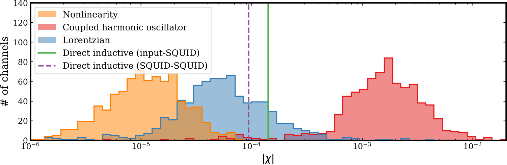
Transition-edge sensor (TES) bolometers are broadly used for background-limited astrophysical measurements from the far-infrared to mm-waves. Many planned future instruments require increasingly large detector arrays, but their scalability is limited by their cryogenic readout electronics. Microwave SQUID multiplexing offers a highly capable scaling solution through the use of inherently broadband circuitry, enabling readout of hundreds to thousands of channels per microwave line. As with any multiplexing technique, the channelization mechanism gives rise to electrical crosstalk which must be understood and controlled so as to not degrade the instrument sensitivity. Here, in this study, we explore implications relevant for TES bolometer array applications, focusing in particular on upcoming mm-wave observatories such as the Simons Observatory and AliCPT. We model the relative contributions of the various underlying crosstalk mechanisms, evaluate the difference between fixed-tone and tone-tracking readout systems, and discuss ways in which crosstalk nonlinearity will complicate on-sky measurements.
- Research Organization:
- SLAC National Accelerator Laboratory (SLAC), Menlo Park, CA (United States)
- Sponsoring Organization:
- USDOE Office of Science (SC), Basic Energy Sciences (BES)
- Grant/Contract Number:
- AC02-76SF00515
- OSTI ID:
- 2446559
- Journal Information:
- Journal of Low Temperature Physics, Journal Name: Journal of Low Temperature Physics Journal Issue: 1-2 Vol. 216; ISSN 0022-2291
- Publisher:
- Springer NatureCopyright Statement
- Country of Publication:
- United States
- Language:
- English




Similar Records
A Scalable Readout for Microwave SQUID Multiplexing of Transition-Edge Sensors
Crosstalk in microwave SQUID multiplexers
Journal Article
·
Wed Nov 14 23:00:00 EST 2018
· Journal of Low Temperature Physics
·
OSTI ID:22809851
Crosstalk in microwave SQUID multiplexers
Journal Article
·
Thu Nov 14 19:00:00 EST 2019
· Applied Physics Letters
·
OSTI ID:1848126