tLaSDI: Thermodynamics-informed latent space dynamics identification
- Korea Institute for Advanced Study (KIAS), Seoul (Korea, Republic of)
- Lawrence Livermore National Laboratory (LLNL), Livermore, CA (United States)
- North Carolina State University, Raleigh, NC (United States); Pohang Univ. of Science and Technology (POSTECH) (Korea, Republic of)
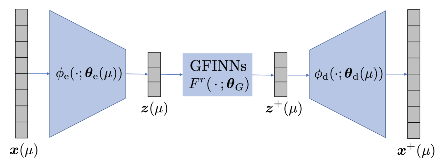
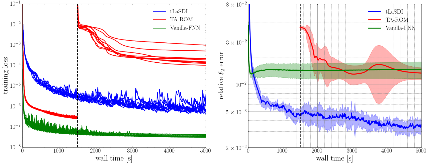
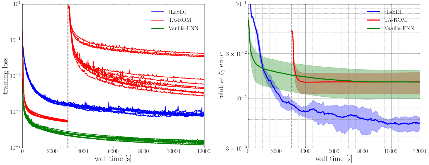
Here we propose a latent space dynamics identification method, namely tLaSDI, that embeds the first and second principles of thermodynamics. The latent variables are learned through an autoencoder as a nonlinear dimension reduction model. The latent dynamics are constructed by a neural network-based model that precisely preserves certain structures for the thermodynamic laws through the GENERIC formalism. An abstract error estimate is established, which provides a new loss formulation involving the Jacobian computation of autoencoder. The autoencoder and the latent dynamics are simultaneously trained to minimize the new loss. Computational examples demonstrate the effectiveness of tLaSDI, which exhibits robust generalization ability, even in extrapolation. In addition, an intriguing correlation is empirically observed between a quantity from tLaSDI in the latent space and the behaviors of the full-state solution.
- Research Organization:
- Lawrence Livermore National Laboratory (LLNL), Livermore, CA (United States)
- Sponsoring Organization:
- USDOE National Nuclear Security Administration (NNSA); USDOE Laboratory Directed Research and Development (LDRD) Program; USDOE Office of Science (SC), Advanced Scientific Computing Research (ASCR)
- Grant/Contract Number:
- AC52-07NA27344; SC0023164
- OSTI ID:
- 2429372
- Report Number(s):
- LLNL--JRNL-860848; 1092545
- Journal Information:
- Computer Methods in Applied Mechanics and Engineering, Journal Name: Computer Methods in Applied Mechanics and Engineering Vol. 429; ISSN 0045-7825
- Publisher:
- ElsevierCopyright Statement
- Country of Publication:
- United States
- Language:
- English




Similar Records
gLaSDI: Parametric physics-informed greedy latent space dynamics identification
Understanding latent timescales in neural ordinary differential equation models of advection-dominated dynamical systems