U.S. Department of Energy
Office of Scientific and Technical Information

Enhancement of phase change material hysteresis model: A case study of modeling building envelope in EnergyPlus

Journal Article · · Energy and Buildings
 [1];  [2];  [2];  [2]
  1. Texas A & M Univ., College Station, TX (United States); OSTI
  2. Texas A & M Univ., College Station, TX (United States)

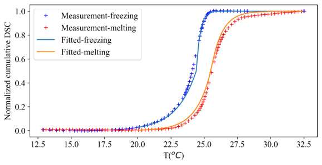
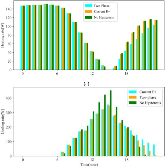
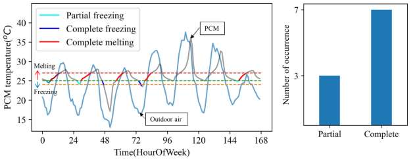
Nowadays, buildings are expected to offer demand side services to the power grid to enhance the electrical load flexibility, which leads to the concepts of grid-interactive efficient buildings (GEBs). Phase change material (PCM)-based thermal energy storage has seen increasing attention in recent years for peak load shifting of grid-interactive efficient buildings (GEBs). Numerical models are critical tools for design and evaluation of PCM-integrated systems. Most industrial-grade PCMs are reported to melt/freeze over a temperature range instead of at a unique temperature. Such thermal hysteresis effect significantly affects the reliability of simulation results because not only the heat transfer process depends on melting and freezing temperatures, the PCM thermal properties change significantly during the phase change process as well. This study is aimed to develop a model for the PCMs used in the building envelope with the capability to accurately simulate hysteretic behaviors. Further, this model is based on a two-phase assumption and is implemented in a whole building energy performance simulation program (i.e., EnergyPlus). A comparison between numerical results and experimental data shows that during a complete phase transition, the two-phase model could achieve a good agreement with the experimental data. During a partial phase transition, the two-phase model could lead to significant improvements compared to other alternative PCM models, including the existing PCM model in EnergyPlus. Last, whole building simulations were performed to study this model's performance regarding heating/cooling loads and zone mean air temperature of a given building. The results show that the difference in hourly heating/cooling loads introduced by the models was less than 1% in design conditions, while significant changes were observed in both hourly heating/cooling loads and zone mean air temperature when the PCM envelope underwent partial phase transition processes.

Research Organization:
Univ. of Alabama, Tuscaloosa, AL (United States)
Sponsoring Organization:
USDOE Office of Energy Efficiency and Renewable Energy (EERE), Energy Efficiency Office. Building Technologies Office
Grant/Contract Number:
EE0008677
OSTI ID:
2418650
Alternate ID(s):
OSTI ID: 1892358
Journal Information:
Energy and Buildings, Journal Name: Energy and Buildings Journal Issue: C Vol. 276; ISSN 0378-7788
Publisher:
ElsevierCopyright Statement
Country of Publication:
United States
Language:
English

References (34)

Theory and modeling of phase change materials with and without mushy regions journal December 1994
A constitutive model for hysteretic phase transition behavior journal April 1994
Mathematical functions for the representation of chromatographic peaks journal October 2001
EnergyPlus: creating a new-generation building energy simulation program journal April 2001
Review on thermal energy storage with phase change: materials, heat transfer analysis and applications journal February 2003
Dynamic building envelope with PCM for cooling purposes – Proof of concept journal February 2019
Analytical modelling of PCM supercooling including recalescence for complete and partial heating/cooling cycles journal May 2021
Verification and validation of EnergyPlus phase change material model for opaque wall assemblies journal August 2012
Numerical model and experimental validation of heat storage with phase change materials journal October 2007
Radiant floors integrated with PCM for indoor temperature control journal November 2011
Review of thermal energy storage technologies based on PCM application in buildings journal December 2013
PCM thermal energy storage tanks in heat pump system for space cooling journal October 2014
Phase change materials (PCM) for cooling applications in buildings: A review journal October 2016
Modelling and experimental validation of an algorithm for simulation of hysteresis effects in phase change materials for building components journal September 2018
Sinusoidal response measurement procedure for the thermal performance assessment of PCM by means of dynamic heat flow meter apparatus journal January 2019
Validation and integration of a latent heat storage model into building envelopes of a high-order building model for Modelica library AixLib journal November 2019
The role of sensitivity analysis in the building performance analysis: A critical review journal February 2020
Sensitivity analysis of cooling demand applied to a large office building journal March 2021
Paraffins as phase change material in a compact plate-fin heat exchanger - Part II: Validation of the “curve scale” hysteresis model for incomplete phase transitions journal February 2021
Advanced parametrisation of phase change materials through kinetic approach journal December 2021
A novel multi-dimensional model for solidification process with supercooling journal March 2017
Modeling hysteresis in the phase transition of industrial-grade solid/liquid PCM for thermal energy storages journal December 2018
Characterization of melting and solidification in a real-scale PCM–air heat exchanger: Experimental results and empirical model journal November 2011
An experimental evaluation of thermal behavior of the building envelope using macroencapsulated PCM for energy savings journal April 2020
A review on phase change material (PCM) for sustainable passive cooling in building envelopes journal July 2016
Resolution of overlapping bands. Functions for simulating band shapes journal January 1969
Heat capacity and other thermodynamic properties of linear macromolecules. II. Polyethylene journal January 1981
Numerical simulation of phase change materials for building applications: a review journal November 2015
Uncertainty and sensitivity decomposition of building energy models journal May 2012
Development and numerical validation of a new model for walls with phase change materials implemented in TRNSYS journal September 2016
Phenomenological modelling of phase transitions with hysteresis in solid/liquid PCM journal September 2019
Modeling of subcooling and solidification of phase change materials journal November 2007
SALib: An open-source Python library for Sensitivity Analysis journal January 2017
Validation of Calibrated Energy Models: Common Errors journal October 2017

Figures / Tables (20)