Frontal Polymerization of Dihydrofuran Comonomer Facilitates Thermoset Deconstruction
- University of Illinois at Urbana-Champaign, IL (United States); EFRC REMAT, University of Illinois at Urbana-Champaign
- University of Illinois at Urbana-Champaign, IL (United States)
- Stanford University, CA (United States)
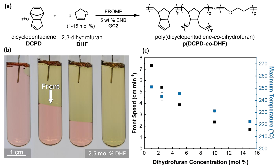
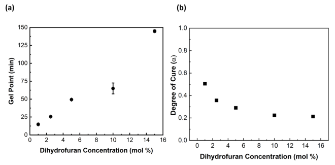
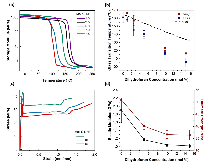
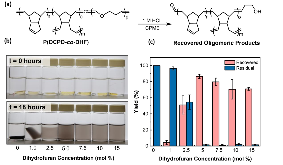
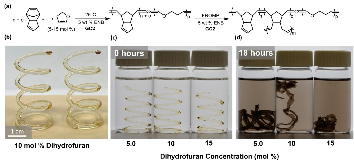
Frontal ring-opening metathesis polymerization (FROMP) is a rapid, low-energy manufacturing reaction that is useful for curing thermosetting materials. FROMP of dicyclopentadiene (DCPD) results in poly(dicyclopentadiene) (p(DCPD)), a tough thermoset with excellent mechanical performance and chemical stability. Like most thermosets, p(DCPD) cannot be reprocessed and is therefore difficult to recycle. Previous work demonstrated that the incorporation of a small quantity of cleavable units in the strand segments of p(DCPD) networks enables their deconstruction. Here, we report that a commercially available multifunctional comonomer, 2,3-dihydrofuran (DHF), both acts as a potent Grubbs catalyst inhibitor during FROMP and introduces acid cleavable units. The resulting materials retain high performance characteristics, including glass-transition temperatures ranging from 115 to 165 °C and ultimate strength ranging from 35 to 40 MPa. The addition of DHF above critical loading levels enables deconstructable thermosets. Here, we further demonstrate freeform three-dimensional (3D) printing of deconstructable thermosets via frontal polymerization.
- Research Organization:
- University of Illinois at Urbana-Champaign, IL (United States)
- Sponsoring Organization:
- USDOE Office of Science (SC), Basic Energy Sciences (BES)
- Grant/Contract Number:
- SC0023457
- OSTI ID:
- 2370403
- Alternate ID(s):
- OSTI ID: 1981831
- Journal Information:
- Chemistry of Materials, Journal Name: Chemistry of Materials Journal Issue: 19 Vol. 34; ISSN 0897-4756
- Publisher:
- American Chemical Society (ACS)Copyright Statement
- Country of Publication:
- United States
- Language:
- English
Similar Records
Cleavable Strand‐Fusing Cross‐Linkers as Additives for Chemically Deconstructable Thermosets with Preserved Thermomechanical Properties