Structural evidence for intermediates during O2 formation in photosystem II
more »
- Lawrence Berkeley National Laboratory (LBNL), Berkeley, CA (United States); SLAC
- Humboldt Univ. of Berlin (Germany)
- Lawrence Berkeley National Laboratory (LBNL), Berkeley, CA (United States)
- Uppsala Univ. (Sweden)
- KTH Royal Inst. of Technology, Stockholm (Sweden)
- Japan Synchrotron Radiation Research Institute, Sayo, Hyogo (Japan); RIKEN SPring-8 Center, Sayo (Japan)
- SLAC National Accelerator Laboratory (SLAC), Menlo Park, CA (United States)
- Lawrence Berkeley National Laboratory (LBNL), Berkeley, CA (United States); Univ. of California, San Francisco, CA (United States); SLAC National Accelerator Laboratory (SLAC), Menlo Park, CA (United States)
- Lawrence Berkeley National Laboratory (LBNL), Berkeley, CA (United States); Univ. of California, Berkeley, CA (United States)
- Univ. of Wisconsin, Madison, WI (United States)
- Uppsala Univ. (Sweden); Umea Univ. (Sweden)
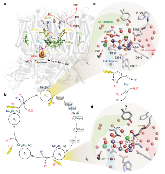
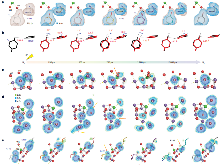
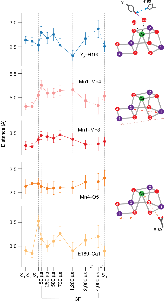
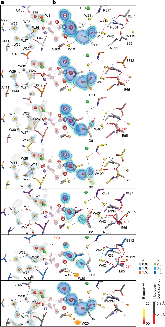
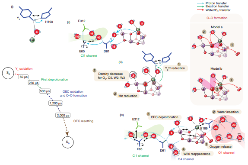
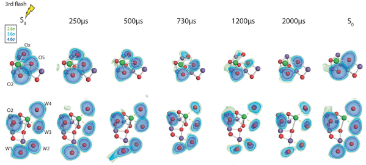
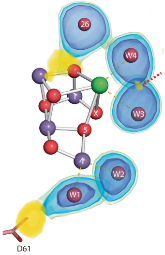
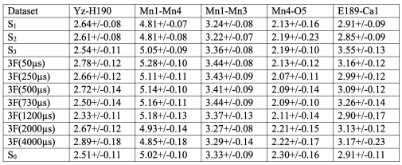
In natural photosynthesis, the light-driven splitting of water into electrons, protons and molecular oxygen forms the first step of the solar-to-chemical energy conversion process. The reaction takes place in photosystem II, where the Mn4CaO5 cluster first stores four oxidizing equivalents, the S0 to S4 intermediate states in the Kok cycle, sequentially generated by photochemical charge separations in the reaction center and then catalyzes the O–O bond formation chemistry. Here, we report room temperature snapshots by serial femtosecond X-ray crystallography to provide structural insights into the final reaction step of Kok’s photosynthetic water oxidation cycle, the S3→[S4]→S0 transition where O2 is formed and Kok’s water oxidation clock is reset. Our data reveal a complex sequence of events, which occur over micro- to milliseconds, comprising changes at the Mn4CaO5 cluster, its ligands and water pathways as well as controlled proton release through the hydrogen-bonding network of the Cl1 channel. Importantly, the extra O atom Ox, which was introduced as a bridging ligand between Ca and Mn1 during the S2→S3 transition disappears or relocates in parallel with Yz reduction starting at approximately 700 μs after the third flash. The onset of O2 evolution, as indicated by the shortening of the Mn1–Mn4 distance, occurs at around 1,200 μs, signifying the presence of a reduced intermediate, possibly a bound peroxide.
- Research Organization:
- Lawrence Berkeley National Laboratory (LBNL), Berkeley, CA (United States); SLAC National Accelerator Laboratory (SLAC), Menlo Park, CA (United States)
- Sponsoring Organization:
- National Institutes of Health (NIH); USDOE National Nuclear Security Administration (NNSA); USDOE Office of Science (SC), Basic Energy Sciences (BES). Chemical Sciences, Geosciences & Biosciences Division (CSGB); USDOE Office of Science (SC), Basic Energy Sciences (BES). Scientific User Facilities (SUF); USDOE Office of Science (SC), Biological and Environmental Research (BER)
- Grant/Contract Number:
- AC02-05CH11231; AC02-76SF00515
- OSTI ID:
- 2001435
- Alternate ID(s):
- OSTI ID: 2228868
- Journal Information:
- Nature (London), Journal Name: Nature (London) Journal Issue: 7961 Vol. 617; ISSN 0028-0836
- Publisher:
- Nature Publishing GroupCopyright Statement
- Country of Publication:
- United States
- Language:
- English

Similar Records
Structures of the intermediates of Kok’s photosynthetic water oxidation clock
Journal Article
·
Tue Nov 06 19:00:00 EST 2018
· Nature (London)
·
OSTI ID:1487213