Single- and multi-component chiral supraparticles as modular enantioselective catalysts
Journal Article
·
· Nature Communications
- State Key Lab of Food Science and Technology, International Joint Research Laboratory for Biointerface and Biodetection, School of Food Science and Technology, Jiangnan University, Wuxi, 214122, Jiangsu, People’s Republic of China Department of Chemi; DOE/OSTI
- Department of Chemical and Biological Engineering, University of Colorado Boulder, Boulder, Colorado, USA
- Department of Chemical Engineering, University of Michigan, Ann Arbor, MI, 48109, USA Biointerfaces Institute, University of Michigan, Ann Arbor, MI, 48109, USA
- State Key Lab of Food Science and Technology, International Joint Research Laboratory for Biointerface and Biodetection, School of Food Science and Technology, Jiangnan University, Wuxi, 214122, Jiangsu, People’s Republic of China
- Department of Chemical Engineering, University of Michigan, Ann Arbor, MI, 48109, USA Biointerfaces Institute, University of Michigan, Ann Arbor, MI, 48109, USA Department of Materials Science, University of Michigan, Ann Arbor, MI, 48109, USA Macrom
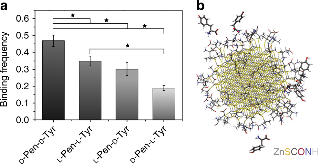
Nanoscale biological assemblies exemplified by exosomes, endosomes and capsids, play crucial roles in all living systems. Supraparticles (SP) from inorganic nanoparticles (NPs) replicate structural characteristics of these bioassemblies, but it is unknown whether they can mimic their biochemical functions. Here, we show that chiral ZnS NPs self-assemble into 70–100 nm SPs that display sub-nanoscale porosity associated with interstitial spaces between constituent NPs. Similarly to photosynthetic bacterial organelles, these SPs can serve as photocatalysts, enantioselectively converting L- or D-tyrosine (Tyr) into dityrosine (diTyr). Experimental data and molecular dynamic simulations indicate that the chiral bias of the photocatalytic reaction is associated with the chiral environment of interstitial spaces and preferential partitioning of enantiomers into SPs, which can be further enhanced by co-assembling ZnS with Au NPs. Besides replicating a specific function of biological nanoassemblies, these findings establish a path to enantioselective oxidative coupling of phenols for biomedical and other needs.
- Research Organization:
- Argonne National Lab. (ANL), Argonne, IL (United States)
- Sponsoring Organization:
- Department of the Army; National Natural Science Foundation of China; National Science Foundation; USDOE Office of Science (SC)
- Grant/Contract Number:
- AC02-06CH11357
- OSTI ID:
- 1624192
- Journal Information:
- Nature Communications, Journal Name: Nature Communications Journal Issue: 1 Vol. 10; ISSN 2041-1723
- Publisher:
- Nature Publishing GroupCopyright Statement
- Country of Publication:
- United States
- Language:
- English
A novel geometric structure of a nanocluster with an irregular kernel: Ag 30 Cu 14 (TPP) 4 (SR) 28
|
journal | January 2020 |



Similar Records
Biomimetic Hierarchical Assembly of Helical Supraparticles from Chiral Nanoparticles
Self-assembly of nanoparticles into biomimetic capsid-like nanoshells
Journal Article
·
Sun Feb 21 19:00:00 EST 2016
· ACS Nano
·
OSTI ID:1440921
Self-assembly of nanoparticles into biomimetic capsid-like nanoshells
Journal Article
·
Sun Nov 06 23:00:00 EST 2016
· Nature Chemistry
·
OSTI ID:1489148