Simulation of shading and algal growth in experimental raceways
- Univ. of Arizona, Tucson, AZ (United States); University of Arizona
- Univ. of Arizona, Tucson, AZ (United States)
- Pacific Northwest National Lab. (PNNL), Richland, WA (United States)
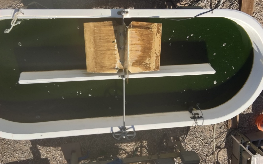
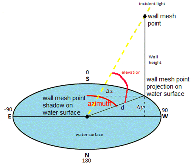
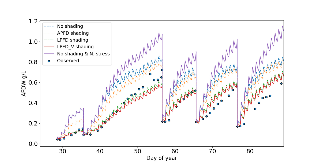
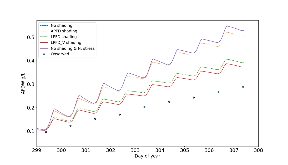
Many algae research groups use elevated experimental raceways to characterize algal biomass productivity. Side walls and a relatively large paddlewheel shade the culture and lower productivity, particularly in winter and with low culture depth. This paper presents a methodology to calculate shading for a given raceway shape: (1) develop a mesh of the inner surface geometry of the raceway; (2) offset the mesh horizontally in the x and y directions on the water surface as a function of wall height, solar zenith angle, and solar azimuth angle; (3) calculate the shaded area for each projected mesh with the shoelace algorithm; (4) use regression to develop a response surface for shaded area as a function of horizontal x and y offset. For each time step, the shaded area is calculated with the regression equation based on the x and y offset at that time step. The shading model was added to the Huesemann Algae Biomass Growth (HABG) model, which predicts algae growth rate as a function of water temperature and light intensity in algae culture layers. The shading model was evaluated with biomass concentrations from three Regional Algal Feedstock Testbed (RAFT) experiments with three different species of algae. The shading algorithm reduced the HABG estimate of productivity and improved the agreement with observed productivities. In the model, productivity was sensitive to the assumed light distribution below the water surface. Averaging light in each layer resulted in higher calculated growth rate than calculating growth separately in shaded and unshaded areas. Shaded area was sensitive to raceway orientation, water depth, and time of year. A north-south raceway orientation had less average shading in winter but more average shading in summer than an east-west orientation.
- Research Organization:
- Univ. of Arizona, Tucson, AZ (United States); Pacific Northwest National Lab. (PNNL), Richland, WA (United States)
- Sponsoring Organization:
- USDOE Office of Energy Efficiency and Renewable Energy (EERE), Bioenergy Technologies Office (EE-3B)
- Grant/Contract Number:
- EE0006269
- OSTI ID:
- 1581781
- Alternate ID(s):
- OSTI ID: 1526791
OSTI ID: 1544628
- Journal Information:
- Algal Research, Journal Name: Algal Research Journal Issue: C Vol. 41; ISSN 2211-9264
- Publisher:
- ElsevierCopyright Statement
- Country of Publication:
- United States
- Language:
- English







Similar Records
Model of temperature, evaporation, and productivity in elevated experimental algae raceways and comparison with commercial raceways
Incorporation of salinity, nitrogen, and shading stress factors into the Huesemann Algae Biomass Growth model