Peking Univ., Beijing (China); Brookhaven National Lab. (BNL), Upton, NY (United States). Sustainable Energy Technologies Dept.
Brookhaven National Lab. (BNL), Upton, NY (United States). Condensed Matter Physics and Materials Science Dept.
Peking Univ., Beijing (China)
Peking Univ., Beijing (China); Brookhaven National Lab. (BNL), Upton, NY (United States). Sustainable Energy Technologies Dept.; Hebei Univ. of Technology, Tianjing (China)
Brookhaven National Lab. (BNL), Upton, NY (United States); Chinese Academy of Sciences (CAS), Ningbo (China). Ningbo Inst. of Materials Technology and Engineering
Brookhaven National Lab. (BNL), Upton, NY (United States). National Synchrotron Light Source
Cornell Univ., Ithaca, NY (United States). Cornell High Energy Synchrotron Source
Argonne National Lab. (ANL), Argonne, IL (United States). Chemical Sciences and Engineering Division; Stanford Univ., CA (United States). Materials Science and Engineering; Imam Abdulrahman Bin Faisal Univ. (IAU), Dammam (Saudi Arabia)
Argonne National Lab. (ANL), Argonne, IL (United States). Chemical Sciences and Engineering Division
Brookhaven National Lab. (BNL), Upton, NY (United States). Sustainable Energy Technologies Dept.
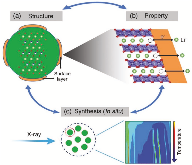
Transition metal layered oxides have been the dominant cathodes in lithium-ion batteries, and among them, high-Ni ones (LiNixMnyCozO2; x ≥ 0.7) with greatly boosted capacity and reduced cost are of particular interest for large-scale applications. The high Ni loading, on the other hand, raises the concern of surface instability and poor rate performance. The rational design of synthesis leading to layered LiNi0.7Mn0.15Co0.15O2 with greatly enhanced rate capability is reflected, by implementing a quenching process alternative to the general slow cooling. In situ synchrotron X-ray diffraction, coupled with surface analysis, is applied to studies of the synthesis process, revealing cooling-induced surface reconstruction involving Li2CO3 accumulation, formation of a Li-deficient layer and Ni reduction at the particle surface. The reconstruction process happens predominantly at high temperatures (above 350 °C) and is highly cooling-rate dependent, implying that surface reconstruction can be suppressed through synthetic control, i.e., quenching to improve the surface stability and rate performance of the synthesized materials. These findings may provide guidance to rational synthesis of high-Ni cathode materials.
@article{osti_1574924,
  author       = {Zhang, Ming‐Jian and Hu, Xiaobing and Li, Maofan and Duan, Yandong and Yang, Luyi and Yin, Chong and Ge, Mingyuan and Xiao, Xianghui and Lee, Wah‐Keat and Ko, Jun Young Peter and others},
  title        = {Cooling Induced Surface Reconstruction during Synthesis of High-Ni Layered Oxides},
  annote       = {Transition metal layered oxides have been the dominant cathodes in lithium-ion batteries, and among them, high-Ni ones (LiNixMnyCozO2; x ≥ 0.7) with greatly boosted capacity and reduced cost are of particular interest for large-scale applications. The high Ni loading, on the other hand, raises the concern of surface instability and poor rate performance. The rational design of synthesis leading to layered LiNi0.7Mn0.15Co0.15O2 with greatly enhanced rate capability is reflected, by implementing a quenching process alternative to the general slow cooling. In situ synchrotron X-ray diffraction, coupled with surface analysis, is applied to studies of the synthesis process, revealing cooling-induced surface reconstruction involving Li2CO3 accumulation, formation of a Li-deficient layer and Ni reduction at the particle surface. The reconstruction process happens predominantly at high temperatures (above 350 °C) and is highly cooling-rate dependent, implying that surface reconstruction can be suppressed through synthetic control, i.e., quenching to improve the surface stability and rate performance of the synthesized materials. These findings may provide guidance to rational synthesis of high-Ni cathode materials.},
  doi          = {10.1002/aenm.201901915},
  url          = {https://www.osti.gov/biblio/1574924},
  journal      = {Advanced Energy Materials},
  issn         = {ISSN 1614-6832},
  number       = {43},
  volume       = {9},
  place        = {United States},
  publisher    = {Wiley},
  year         = {2019},
  month        = {10}}
Brookhaven National Laboratory (BNL), Upton, NY (United States)
Sponsoring Organization:
USDOE Office of Energy Efficiency and Renewable Energy (EERE), Vehicle Technologies Office; USDOE Office of Science (SC), Basic Energy Sciences (BES). Materials Sciences & Engineering Division
Grant/Contract Number:
SC0012704; AC02-06CH11357
OSTI ID:
1574924
Alternate ID(s):
OSTI ID: 1763743 OSTI ID: 1570394
Report Number(s):
BNL--212356-2019-JAAM; BNL--212443-2019-JAAM
Journal Information:
Advanced Energy Materials, Journal Name: Advanced Energy Materials Journal Issue: 43 Vol. 9; ISSN 1614-6832