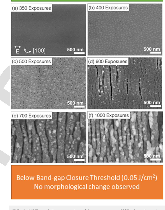
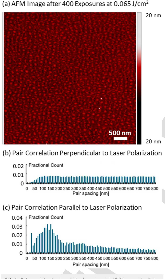
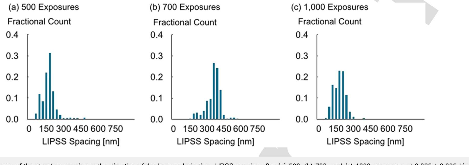
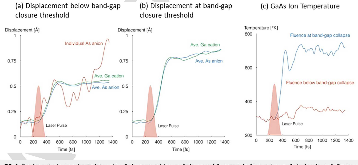
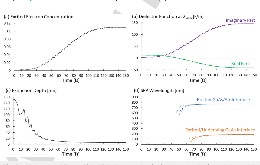
The interaction among multiple intense ultrashort laser pulses and solids is known to provide a regular nanoscale surface corrugation. A coupled mechanism has been identified that operates in a specific range of fluences in GaAs that exhibits transient loss of the imaginary part of the dielectric function and Χ2, which produces a unique corrugation known as high spatial frequency laser induced periodic surface structures (HSFL). The final structures have 180 nm periods, and their alignment perpendicular to the laser polarization is first observed in an intermediate morphology with correlation distances of 150±40 nm. Quantum molecular dynamics simulations suggest that HSFL self-assembly is initiated when the intense laser field softens the interatomic binding potential, which leads to an ultrafast generation of point defects. The morphological evolution begins as self-interstitial diffusion, driven by stress relaxation, to the surface producing 1–2 nm tall islands. An ab initio calculation of excited electron concentration combined with a Drude-Lorentz model of the excited GaAs dielectric function is used to determine that the conditions for SPP coupling at HSFL formation fluences are both satisfied and occur at wavelengths that are imprinted into the observed surface morphologies. The evolution of these morphologies is reported on as the interplay between surface plasmon polaritons that localize defect generation within the structures present on the previous laser exposure and stress relaxation driven defect diffusion.
Abere, Michael J., et al. "Alignment of morphology during high spatial frequency periodic structure formation in GaAs." Journal of Applied Physics, vol. 126, no. 14, Oct. 2019. https://doi.org/10.1063/1.5114930
Abere, Michael J., Yalisove, Steven M., & Torralva, Ben (2019). Alignment of morphology during high spatial frequency periodic structure formation in GaAs. Journal of Applied Physics, 126(14). https://doi.org/10.1063/1.5114930
Abere, Michael J., Yalisove, Steven M., and Torralva, Ben, "Alignment of morphology during high spatial frequency periodic structure formation in GaAs," Journal of Applied Physics 126, no. 14 (2019), https://doi.org/10.1063/1.5114930
@article{osti_1574451,
  author       = {Abere, Michael J. and Yalisove, Steven M. and Torralva, Ben},
  title        = {Alignment of morphology during high spatial frequency periodic structure formation in GaAs},
  annote       = {The interaction among multiple intense ultrashort laser pulses and solids is known to provide a regular nanoscale surface corrugation. A coupled mechanism has been identified that operates in a specific range of fluences in GaAs that exhibits transient loss of the imaginary part of the dielectric function and Χ2, which produces a unique corrugation known as high spatial frequency laser induced periodic surface structures (HSFL). The final structures have 180 nm periods, and their alignment perpendicular to the laser polarization is first observed in an intermediate morphology with correlation distances of 150±40 nm. Quantum molecular dynamics simulations suggest that HSFL self-assembly is initiated when the intense laser field softens the interatomic binding potential, which leads to an ultrafast generation of point defects. The morphological evolution begins as self-interstitial diffusion, driven by stress relaxation, to the surface producing 1–2 nm tall islands. An ab initio calculation of excited electron concentration combined with a Drude-Lorentz model of the excited GaAs dielectric function is used to determine that the conditions for SPP coupling at HSFL formation fluences are both satisfied and occur at wavelengths that are imprinted into the observed surface morphologies. The evolution of these morphologies is reported on as the interplay between surface plasmon polaritons that localize defect generation within the structures present on the previous laser exposure and stress relaxation driven defect diffusion.},
  doi          = {10.1063/1.5114930},
  url          = {https://www.osti.gov/biblio/1574451},
  journal      = {Journal of Applied Physics},
  issn         = {ISSN 0021-8979},
  number       = {14},
  volume       = {126},
  place        = {United States},
  publisher    = {American Institute of Physics (AIP)},
  year         = {2019},
  month        = {10}}