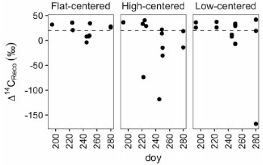
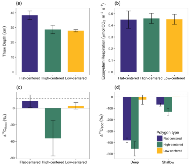
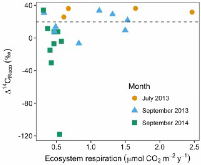
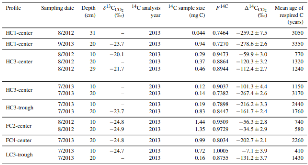
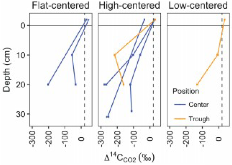
Radiocarbon measurements of ecosystem respiration and soil pore space CO2 are useful for determining the sources of ecosystem respiration,identifying environmental controls on soil carbon cycling rates, and parameterizing and evaluating models of the carbon cycle. We measured flux rates and radiocarbon content of ecosystem respiration, as well as radiocarbon in soil profile CO2 in Utqiagvik (Barrow), Alaska, during the summers of 2012, 2013, and 2014.We found that radiocarbon in ecosystem respiration(Δ14CReco) ranged from +60.5 to –160‰ with a median value of +23.3‰. Ecosystem respiration became more depleted in radiocarbon from summer to autumn, indicating increased decomposition of old soil organic carbon and/or decreased CO2 production from fast-cycling carbon pools. Across permafrost features,ecosystem respiration from high-centered polygons was depleted in radiocarbon relative to other polygon types. Radiocarbon content in soil pore-space CO2 varied between –7.1 and –280‰, becoming more negative with depth in individual soil profiles. These pore-space radiocarbon values correspond to CO2 mean ages of 410 to 3350 years, based on a steady-state, one-pool model. Together, these data indicate that deep soil respiration was derived primarily from old, slow-cycling carbon, but that total CO2 fluxes depended largely on autotrophic respiration and heterotrophic decomposition of fast-cycling carbon within the shallowest soil layers. The relative contributions of these different CO2 sources were highly variable across microtopographic features and time in the sampling season. The highly negative Δ14C values in soil pore-space CO2 and autumn ecosystem respiration indicate that when it is not frozen, very old soil carbon is vulnerable to decomposition.
Vaughn, Lydia J. S. and Torn, Margaret S.. "Radiocarbon measurements of ecosystem respiration and soil pore-space CO<sub>2</sub> in Utqiagvik (Barrow), Alaska." Earth System Science Data (Online), vol. 10, no. 4, Oct. 2018. https://doi.org/10.5194/essd-10-1943-2018
Vaughn, Lydia J. S., & Torn, Margaret S. (2018). Radiocarbon measurements of ecosystem respiration and soil pore-space CO<sub>2</sub> in Utqiagvik (Barrow), Alaska. Earth System Science Data (Online), 10(4). https://doi.org/10.5194/essd-10-1943-2018
Vaughn, Lydia J. S., and Torn, Margaret S., "Radiocarbon measurements of ecosystem respiration and soil pore-space CO<sub>2</sub> in Utqiagvik (Barrow), Alaska," Earth System Science Data (Online) 10, no. 4 (2018), https://doi.org/10.5194/essd-10-1943-2018
@article{osti_1563968,
  author       = {Vaughn, Lydia J. S. and Torn, Margaret S.},
  title        = {Radiocarbon measurements of ecosystem respiration and soil pore-space CO<sub>2</sub> in Utqiagvik (Barrow), Alaska},
  annote       = { Radiocarbon measurements of ecosystem respiration and soil pore space CO2 are useful for determining the sources of ecosystem respiration,identifying environmental controls on soil carbon cycling rates, and parameterizing and evaluating models of the carbon cycle. We measured flux rates and radiocarbon content of ecosystem respiration, as well as radiocarbon in soil profile CO2 in Utqiagvik (Barrow), Alaska, during the summers of 2012, 2013, and 2014.We found that radiocarbon in ecosystem respiration(Δ14CReco) ranged from +60.5 to –160‰ with a median value of +23.3‰. Ecosystem respiration became more depleted in radiocarbon from summer to autumn, indicating increased decomposition of old soil organic carbon and/or decreased CO2 production from fast-cycling carbon pools. Across permafrost features,ecosystem respiration from high-centered polygons was depleted in radiocarbon relative to other polygon types. Radiocarbon content in soil pore-space CO2 varied between –7.1 and –280‰, becoming more negative with depth in individual soil profiles. These pore-space radiocarbon values correspond to CO2 mean ages of 410 to 3350 years, based on a steady-state, one-pool model. Together, these data indicate that deep soil respiration was derived primarily from old, slow-cycling carbon, but that total CO2 fluxes depended largely on autotrophic respiration and heterotrophic decomposition of fast-cycling carbon within the shallowest soil layers. The relative contributions of these different CO2 sources were highly variable across microtopographic features and time in the sampling season. The highly negative Δ14C values in soil pore-space CO2 and autumn ecosystem respiration indicate that when it is not frozen, very old soil carbon is vulnerable to decomposition.},
  doi          = {10.5194/essd-10-1943-2018},
  url          = {https://www.osti.gov/biblio/1563968},
  journal      = {Earth System Science Data (Online)},
  issn         = {ISSN 1866-3516},
  number       = {4},
  volume       = {10},
  place        = {United States},
  publisher    = {Copernicus},
  year         = {2018},
  month        = {10}}
Next Generation Ecosystems Experiment - Arctic, Oak Ridge National Laboratory (ORNL), Oak Ridge, TN (US); NGEE Arctic, Oak Ridge National Laboratory (ORNL), Oak Ridge, TN (United States)https://doi.org/10.5440/1129476
Next Generation Ecosystems Experiment - Arctic, Oak Ridge National Laboratory (ORNL), Oak Ridge, TN (US); NGEE Arctic, Oak Ridge National Laboratory (ORNL), Oak Ridge, TN (United States)https://doi.org/10.5440/1418853