Assessing an experimental approach for chemical explosive mode and heat release rate using DNS data
Journal Article
·
· Combustion and Flame
- Univ. of Applied Sciences, Darmstadt (Germany); TU Darmstadt, Darmstadt (Germany)
- Univ. of Applied Sciences, Darmstadt (Germany)
- TU Darmstadt, Darmstadt (Germany)
- Univ. of Connecticut, Storrs, CT (United States)
- The Univ. of New South Wales, NSW (Australia)
- Sandia National Lab. (SNL-CA), Livermore, CA (United States)
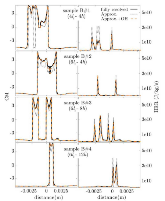
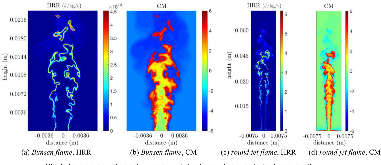
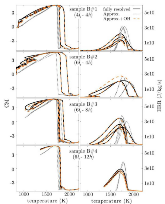
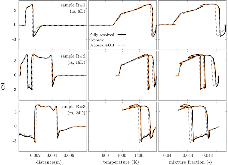
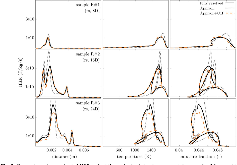
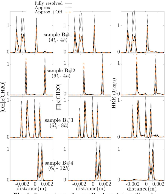
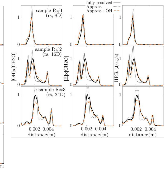
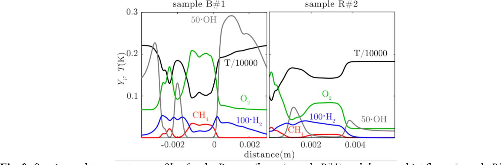
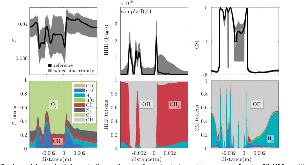
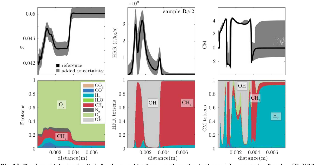
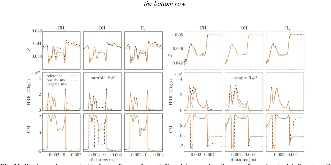
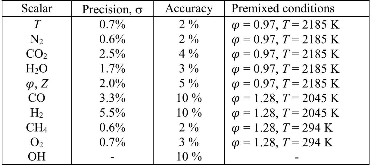
Obtaining information about burning characteristics and flame structures by analyzing experimental data is an important issue for understanding combustion processes and pursuing combustion modeling approaches. It has been shown that Raman/Rayleigh measurements of major species and temperature can be used to approximate the local heat release rate and the chemical explosive mode, and that these results are sufficiently accurate for a qualitative assessment of the relative importance of different heat release zones within the same overall flame structure in laminar and mildly turbulent partially premixed flames. The present study uses data from direct numerical simulation (DNS) to extend and quantify the understanding of the approximation method with respect to premixed and stratified-premixed flames with significant turbulence–chemistry interaction (high Karlovitz number). Here, the accuracy of the approximation procedure is assessed as previously applied, using just major species and temperature, as well as with the OH radical included as an additional experimentally accessible species. The accuracy of the local chemical explosive mode and the local heat release rate results from the approximation are significantly improved with OH included, yielding quantitative agreement with the DNS results. Further, a global sensitivity analysis is applied to identify the sensitivity of the heat release rate and chemical explosive mode to experimental uncertainties imprinted upon the DNS data prior to the approximation procedure.
- Research Organization:
- Sandia National Laboratories (SNL-CA), Livermore, CA (United States)
- Sponsoring Organization:
- USDOE; USDOE Office of Science (SC), Basic Energy Sciences (BES) (SC-22)
- Grant/Contract Number:
- AC04-94AL85000; NA0003525
- OSTI ID:
- 1559499
- Alternate ID(s):
- OSTI ID: 1547942
- Report Number(s):
- SAND--2019-8792J; 677931
- Journal Information:
- Combustion and Flame, Journal Name: Combustion and Flame Journal Issue: C Vol. 209; ISSN 0010-2180
- Publisher:
- ElsevierCopyright Statement
- Country of Publication:
- United States
- Language:
- English
Similar Records
Assessing the relative importance of flame regimes in Raman/Rayleigh line measurements of turbulent lifted flames
Turbulent flame-wall interaction: a DNS study
(Towards) DNS of a Laboratory Lean CH4/H2 Low-Swirl Flame Impinging on an Inclined Wall
Journal Article
·
Thu Jul 05 20:00:00 EDT 2018
· Proceedings of the Combustion Institute
·
OSTI ID:1497649
Turbulent flame-wall interaction: a DNS study
Journal Article
·
Thu Dec 31 23:00:00 EST 2009
· Journal of Fluid Mechanics
·
OSTI ID:1043299
(Towards) DNS of a Laboratory Lean CH4/H2 Low-Swirl Flame Impinging on an Inclined Wall
Conference
·
Sun Sep 25 20:00:00 EDT 2022
·
OSTI ID:1890460