U.S. Department of Energy
Office of Scientific and Technical Information

Comparative study of the cooling energy performance of variable refrigerant flow systems and variable air volume systems in office buildings

Journal Article · · Applied Energy
 [1];  [1];  [2];  [2];  [3]
  1. Tsinghua Univ., Beijing (China)
  2. Lawrence Berkeley National Lab. (LBNL), Berkeley, CA (United States)
  3. Beijing Inst. of Architectural Design, Beijing (China)
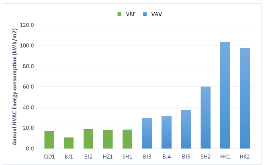
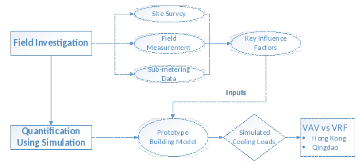
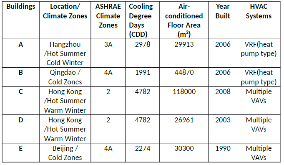
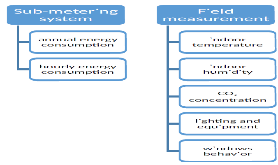
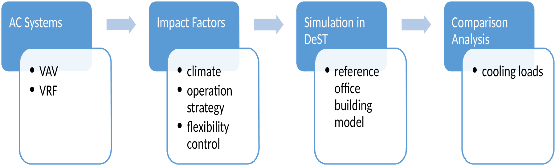
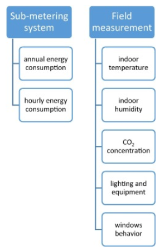
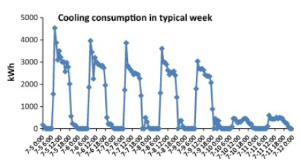
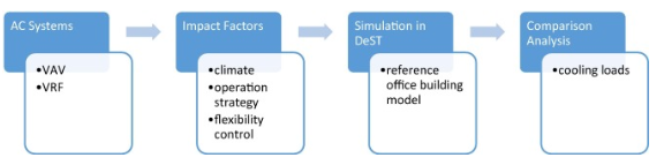
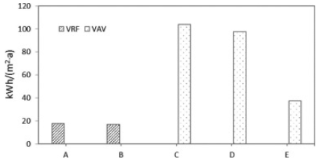
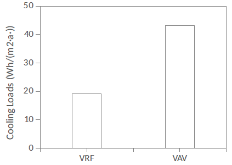
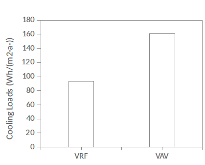
Variable air volume (VAV) and variable refrigerant flow (VRF) systems are widely used in office buildings. This study investigated VAV and VRF systems in five typical office buildings in China, and compared their cooling energy use. Site survey and field measurements were conducted to collect the data of building characteristics and operation. Measured cooling electricity use was collected from sub-metering in the five buildings. The sub-metering data normalized by climate and operating hours indicated that the cooling energy consumed by VRF systems was up to 70% lower than that consumed by VAV systems. This was mainly because of the different operation modes of both system types that led to significantly fewer operating hours for the VRF systems. Building simulations were used to quantify the impact of operation modes of VRF and VAV systems on cooling loads. A prototype office building in China was used as the model. The simulation results showed that the VRF operation mode required much lower cooling load when compared to the VAV operation mode. For example, the cooling loads decreased by 42% in Hong Kong and 53% in Qingdao. Key findings include the following: the VRF systems operated in the part-time-part-space mode enabling occupants to turn on the air-conditioning only when needed and when the spaces were occupied. However, the VAV systems operated in the full-time-full-space mode limiting occupants’ control of operation. These findings provide insights into VRF systems operation and controls as well as their energy performance, which could help guide HVAC designers on system selection and building operators or facility managers on system operations to achieve low- or zero-net energy buildings.
Research Organization:
Lawrence Berkeley National Laboratory (LBNL), Berkeley, CA (United States)
Sponsoring Organization:
USDOE Office of Energy Efficiency and Renewable Energy (EERE)
Grant/Contract Number:
AC02-05CH11231
OSTI ID:
1532210
Alternate ID(s):
OSTI ID: 1396996
Journal Information:
Applied Energy, Journal Name: Applied Energy Journal Issue: C Vol. 183; ISSN 0306-2619
Publisher:
ElsevierCopyright Statement
Country of Publication:
United States
Language:
English

References (35)

DeST — An integrated building simulation toolkit Part I: Fundamentals journal June 2008
DeST—An integrated building simulation toolkit Part II: Applications journal August 2008
A novel approach for building occupancy simulation journal June 2011
Development of web-based information technology infrastructures and regulatory repositories for green building codes in China (iCodes) journal April 2013
A detailed loads comparison of three building energy modeling programs: EnergyPlus, DeST and DOE-2.1E journal April 2013
Comparison of HVAC system modeling in EnergyPlus, DeST and DOE-2.1E journal September 2013
A new multizone model for the simulation of building thermal performance journal March 1997
Energy optimized-ventilation constrained variable air volume system control journal September 1997
An analysis of climatic influences on chiller plant electricity consumption journal June 2009
Thermal comfort in residential buildings: Comfort values and scales for building energy simulation journal May 2009
Energy efficient fuzzy based combined variable refrigerant volume and variable air volume air conditioning system for buildings journal April 2010
Experimental validation of the simulation module of the water-cooled variable refrigerant flow system under cooling operation journal May 2010
Impact of climate change on commercial sector air conditioning energy consumption in subtropical Hong Kong journal July 2010
Review of building energy-use performance benchmarking methodologies journal May 2011
Building operation and energy performance: Monitoring, analysis and optimisation toolkit journal January 2013
Impact of climate change on building energy use in different climate zones and mitigation and adaptation implications journal September 2012
Achieving better energy-efficient air conditioning – A review of technologies and strategies journal April 2013
A review on simulation-based optimization methods applied to building performance analysis journal January 2014
Thermal comfort and building energy consumption implications – A review journal February 2014
A pattern-based automated approach to building energy model calibration journal March 2016
Control and energy simulation of variable refrigerant flow air conditioning system combined with outdoor air processing unit journal March 2014
Stochastic modeling of overtime occupancy and its application in building energy simulation and calibration journal September 2014
Optimal supply air temperature with respect to energy use in a variable air volume system journal March 2004
Energy simulation in the variable refrigerant flow air-conditioning system under cooling conditions journal February 2007
Evaluation program for the energy-saving of variable-air-volume systems journal May 2007
A review on buildings energy consumption information journal January 2008
Simulation and experimental validation of the variable-refrigerant-volume (VRV) air-conditioning system in EnergyPlus journal January 2008
Modeling and energy simulation of the variable refrigerant flow air conditioning system with water-cooled condenser under cooling conditions journal September 2009
Simulation comparison of VAV and VRF air conditioning systems in an existing building for the cooling season journal November 2009
Comparison of energy efficiency between variable refrigerant flow systems and ground source heat pump systems journal May 2010
Variable refrigerant flow systems: A review journal July 2010
Building energy use in China: Ceiling and scenario journal September 2015
Occupant behavior modeling for building performance simulation: Current state and future challenges journal November 2015
Development and application of the load responsive control of the evaporating temperature in a VRF system for cooling energy savings journal March 2016
Generic simulation model of multi-evaporator variable refrigerant flow air conditioning system for control analysis journal September 2013

Cited By (5)

Heat pump system assessment for a groundwater‐source municipal drinking water utility journal October 2018
Modelling of a Variable Refrigerant Flow System in EnergyPlus for Building Energy Simulation in an Open Building Information Modelling Environment journal December 2018
Detailed Comparison of the Operational Characteristics of Energy-Conserving HVAC Systems during the Cooling Season journal October 2019
Energy Modelling and Indoor Air Quality Analysis of Cooling Systems for Buildings in Hot Climates journal October 2018
A Comparison of the Environmental Performance of Cooling and Heating among Different Household Types in China’s Hot Summer–Cold Winter Zone journal October 2019

Figures / Tables (24)


Similar Records

Operation and performance of VRF systems: Mining a large-scale dataset
Journal Article · Thu Dec 31 19:00:00 EST 2020 · Energy and Buildings · OSTI ID:1783137