U.S. Department of Energy
Office of Scientific and Technical Information

Aquifer environment selects for microbial species cohorts in sediment and groundwater

Journal Article · · The ISME Journal
DOI:https://doi.org/10.1038/ismej.2015.2· OSTI ID:1512234
 [1];  [1];  [2];  [3];  [4];  [5];  [6]
  1. Univ. of California, Berkeley, CA (United States). Dept. of Earth and Planetary Science
  2. Univ. of California, Berkeley, CA (United States). Dept. of Plant and Microbial Biology
  3. Columbia Univ., New York, NY (United States). Dept. of Earth and Environmental Science
  4. Lawrence Berkeley National Lab. (LBNL), Berkeley, CA (United States). Geophysics Dept. Earth Sciences Division
  5. USDOE Joint Genome Institute (JGI), Walnut Creek, CA (United States). Metagenome Program
  6. Univ. of California, Berkeley, CA (United States). Dept. of Earth and Planetary Science. Dept. of Environmental Science, Policy, and Management
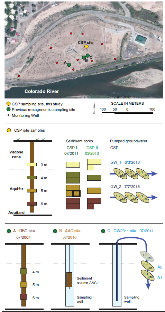
Little is known about the biogeography or stability of sediment-associated microbial community membership because these environments are biologically complex and generally difficult to sample. High-throughput-sequencing methods provide new opportunities to simultaneously genomically sample and track microbial community members across a large number of sampling sites or times, with higher taxonomic resolution than is associated with 16 S ribosomal RNA gene surveys, and without the disadvantages of primer bias and gene copy number uncertainty. We characterized here a sediment community at 5 m depth in an aquifer adjacent to the Colorado River and tracked its most abundant 133 organisms across 36 different sediment and groundwater samples. We sampled sites separated by centimeters, meters and tens of meters, collected on seven occasions over 6 years. Analysis of 1.4 terabase pairs of DNA sequence showed that these 133 organisms were more consistently detected in saturated sediments than in samples from the vadose zone, from distant locations or from groundwater filtrates. Abundance profiles across aquifer locations and from different sampling times identified organism cohorts that comprised subsets of the 133 organisms that were consistently associated. The data suggest that cohorts are partly selected for by shared environmental adaptation.
Research Organization:
Lawrence Berkeley National Laboratory (LBNL), Berkeley, CA (United States)
Sponsoring Organization:
USDOE Office of Science (SC), Biological and Environmental Research (BER) (SC-23)
Grant/Contract Number:
AC02-05CH11231; SC0004918
OSTI ID:
1512234
Journal Information:
The ISME Journal, Journal Name: The ISME Journal Journal Issue: 8 Vol. 9; ISSN 1751-7362
Publisher:
Nature Publishing GroupCopyright Statement
Country of Publication:
United States
Language:
English

References (44)

Comparison of bacteria from deep subsurface sediment and adjacent groundwater journal December 1991
Basic local alignment search tool journal October 1990
Groundwater samples do not reflect bacterial densities and activity in subsurface systems journal April 1997
Uranium removal from groundwater via in situ biostimulation: Field-scale modeling of transport and biological processes journal August 2007
Microbial Incorporation of 13 C-Labeled Acetate at the Field Scale:  Detection of Microbes Responsible for Reduction of U(VI) journal December 2005
Mineral Transformation and Biomass Accumulation Associated With Uranium Bioremediation at Rifle, Colorado journal July 2009
Attached and suspended microbial communities in a pristine confined aquifer: ATTACHED AND SUSPENDED MICROBIAL COMMUNITIES journal July 2008
Metabolic interdependencies between phylogenetically novel fermenters and respiratory organisms in an unconfined aquifer journal March 2014
Genome sequences of rare, uncultured bacteria obtained by differential coverage binning of multiple metagenomes journal May 2013
Extraordinary phylogenetic diversity and metabolic versatility in aquifer sediment journal August 2013
Diverse uncultivated ultra-small bacterial cells in groundwater journal February 2015
Fast gapped-read alignment with Bowtie 2 journal March 2012
Microbial biogeography: putting microorganisms on the map journal February 2006
Microbial diversity and the genetic nature of microbial species journal May 2008
Uniting the classification of cultured and uncultured bacteria and archaea using 16S rRNA gene sequences journal August 2014
A sand fly salivary protein acts as a neutrophil chemoattractant journal May 2021
Global distribution of microbial abundance and biomass in subseafloor sediment journal August 2012
Using Stable Isotope Probing to Characterize Differences Between Free-Living and Sediment-Associated Microorganisms in the Subsurface journal February 2013
RAxML-VI-HPC: maximum likelihood-based phylogenetic analyses with thousands of taxa and mixed models journal August 2006
UniRef: comprehensive and non-redundant UniProt reference clusters journal March 2007
IDBA-UD: a de novo assembler for single-cell and metagenomic sequencing data with highly uneven depth journal April 2012
KEGG: Kyoto Encyclopedia of Genes and Genomes journal January 1999
MUSCLE: multiple sequence alignment with high accuracy and high throughput journal March 2004
KEGG for integration and interpretation of large-scale molecular data sets journal November 2011
The bacterial species definition in the genomic era
  • Konstantinidis, Konstantinos T.; Ramette, Alban; Tiedje, James M.
  • Philosophical Transactions of the Royal Society B: Biological Sciences, Vol. 361, Issue 1475 https://doi.org/10.1098/rstb.2006.1920
journal October 2006
Time series community genomics analysis reveals rapid shifts in bacterial species, strains, and phage during infant gut colonization journal August 2012
Accurate, multi-kb reads resolve complex populations and detect rare microorganisms journal February 2015
Geographic Barriers Isolate Endemic Populations of Hyperthermophilic Archaea journal August 2003
Genome-Wide Experimental Determination of Barriers to Horizontal Gene Transfer journal November 2007
Fermentation, Hydrogen, and Sulfur Metabolism in Multiple Uncultivated Bacterial Phyla journal September 2012
Proteogenomic Monitoring of Geobacter Physiology during Stimulated Uranium Bioremediation journal August 2009
Effect of organic contamination upon microbial distributions and heterotrophic uptake in a Cape Cod, Mass., aquifer. journal January 1984
Importance of unattached bacteria and bacteria attached to sediment in determining potentials for degradation of xenobiotic organic contaminants in an aerobic aquifer. journal January 1992
Horizontal Heterogeneity of Denitrifying Bacterial Communities in Marine Sediments by Terminal Restriction Fragment Length Polymorphism Analysis journal May 2000
Composition and Diversity of Microbial Communities Recovered from Surrogate Minerals Incubated in an Acidic Uranium-Contaminated Aquifer journal October 2004
Specific Bacterial, Archaeal, and Eukaryotic Communities in Tidal-Flat Sediments along a Vertical Profile of Several Meters journal April 2006
Small Genomes and Sparse Metabolisms of Sediment-Associated Bacteria from Four Candidate Phyla journal October 2013
Prodigal: prokaryotic gene recognition and translation initiation site identification journal March 2010
MUSCLE: a multiple sequence alignment method with reduced time and space complexity journal August 2004
Functional microbial diversity explains groundwater chemistry in a pristine aquifer journal January 2013
Community genomic analyses constrain the distribution of metabolic traits across the Chloroflexi phylum and indicate roles in sediment carbon cycling journal January 2013
A simple, fast, and accurate method of phylogenomic inference journal January 2008
progressiveMauve: Multiple Genome Alignment with Gene Gain, Loss and Rearrangement journal June 2010
Phylogeny of Bacterial and Archaeal Genomes Using Conserved Genes: Supertrees and Supermatrices journal April 2013

Cited By (3)

The selective pressures on the microbial community in a metal-contaminated aquifer journal December 2018
Critical biogeochemical functions in the subsurface are associated with bacteria from new phyla and little studied lineages: N- and C-cycling organisms in the subsurface journal July 2015
Evidence for Microbial Mediated NO3− Cycling Within Floodplain Sediments During Groundwater Fluctuations journal July 2019

Figures / Tables (3)