Efficient Thick-Film Polymer Solar Cells with Enhanced Fill Factors via Increased Fullerene Loading
Journal Article
·
· ACS Applied Materials and Interfaces
- South China Univ. of Technology, Guangzhou (China). Inst. of Polymer Optoelectronic Materials and Devices. State Key Lab. of Luminescent Materials and Devices; Eindhoven Univ. of Technology (Netherlands). Molecular Materials and Nanosystems. Inst. for Complex Molecular Systems; North Carolina State University
- North Carolina State Univ., Raleigh, NC (United States). Dept. of Physics. Organic and Carbon Electronics Labs (ORaCEL)
- Eindhoven Univ. of Technology (Netherlands). Molecular Materials and Nanosystems. Inst. for Complex Molecular Systems
- South China Univ. of Technology, Guangzhou (China). Inst. of Polymer Optoelectronic Materials and Devices. State Key Lab. of Luminescent Materials and Devices
- Eindhoven Univ. of Technology (Netherlands). Molecular Materials and Nanosystems. Inst. for Complex Molecular Systems; Dutch Inst. for Fundamental Energy Research, Eindhoven (Netherlands)
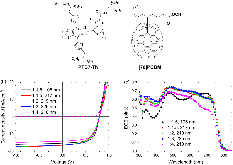
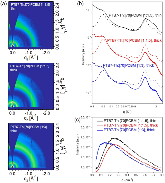
Developing effective methods to make efficient bulk-heterojunction polymer solar cells at roll-to-roll relevant active layer thickness is of significant importance. We investigate the effect of fullerene content in polymer:fullerene blends on the fill factor (FF) and on the performance of thick-film solar cells for four different donor polymers PTB7-Th, PDPP-TPT, BDT-FBT-2T, and poly[5,5'-bis(2-butyloctyl)-(2,2'-bithiophene)-4,4'-dicarboxylate-alt-5,5'-2,2'-bithiophene] (PDCBT). At a few hundreds of nanometers thickness, increased FFs are observed in all cases and improved overall device performances are obtained except for PDCBT upon increasing fullerene content in blend films. This fullerene content effect was studied in more detail by electrical and morphological characterization. The results suggest enhanced electron mobility and suppressed bimolecular recombination upon increasing fullerene content in thick polymer:fullerene blend films, which are the result of larger fullerene aggregates and improved interconnectivity of the fullerene phases that provide continuous percolating pathways for electron transport in thick films. These findings are important because an effective and straightforward method that enables fabricating efficient thick-film polymer solar cells is desirable for large-scale manufacturing via roll-to-roll processing and for multijunction devices.
- Research Organization:
- Eindhoven Univ. of Technology (Netherlands); North Carolina State Univ., Raleigh, NC (United States); South China Univ. of Technology, Guangzhou (China)
- Sponsoring Organization:
- European Research Council (ERC); Ministry of Education, Culture and Science (Netherlands); Ministry of Science and Technology (China); Office of Naval Research (ONR) (United States); Recruitment Program of Global Youth Experts of China; USDOE Office of Science (SC), Basic Energy Sciences (BES) (SC-22)
- Grant/Contract Number:
- AC02-05CH11231
- OSTI ID:
- 1508784
- Journal Information:
- ACS Applied Materials and Interfaces, Journal Name: ACS Applied Materials and Interfaces Journal Issue: 11 Vol. 11; ISSN 1944-8244
- Publisher:
- American Chemical Society (ACS)Copyright Statement
- Country of Publication:
- United States
- Language:
- English



Similar Records
Electronic structure disorder, vibronic coupling, and charge transfer excitons in poly(fluorene-alt-bithiophene):fullerene films
Tuning the properties of polymer bulk heterojunction solar cells by adjusting fullerene size to control intercalation
Journal Article
·
Mon Mar 18 00:00:00 EDT 2013
· Applied Physics Letters
·
OSTI ID:22162804
Tuning the properties of polymer bulk heterojunction solar cells by adjusting fullerene size to control intercalation
Journal Article
·
Tue Feb 23 23:00:00 EST 2010
· Nano Letters
·
OSTI ID:972658