Incorporation of the Rotor-Equivalent Wind Speed into the Weather Research and Forecasting Model’s Wind Farm Parameterization
Journal Article
·
· Monthly Weather Review
- Univ. of Colorado, Boulder, CO (United States). Dept. of Atmospheric and Oceanic Sciences, and the Cooperative Inst. for Research in Environmental Sciences
- National Oceanic and Atmospheric Administration (NOAA), Boulder, CO (United States). Cooperative Inst. for Research in Environmental Sciences, Global Systems Division
- Univ. of Colorado, Boulder, CO (United States). Dept. of Atmospheric and Oceanic Sciences
- Vibrant Clean Energy, Boulder (Colorado)
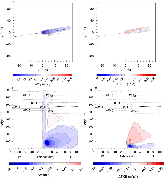
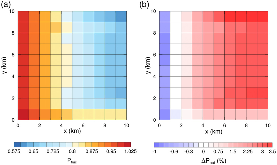
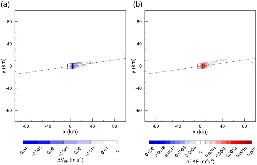
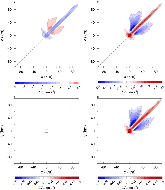
Wind power installations have been increasing in recent years. Because wind turbines can influence local wind speeds, temperatures, and surface fluxes, weather forecasting models should consider their effects. Wind farm parameterizations do currently exist for numerical weather prediction models. They generally consider two turbine impacts: elevated drag in the region of the wind turbine rotor disk and increased turbulent kinetic energy production. The wind farm parameterization available in the Weather Research and Forecasting (WRF) Model calculates this drag and TKE as a function of hub-height wind speed. However, recent work has suggested that integrating momentum over the entire rotor disk [via a rotor-equivalent wind speed (REWS)] is more appropriate, especially for cases with high wind shear. In this study, we implement the REWS in the WRF wind farm parameterization and evaluate its impacts in an idealized environment, with varying amounts of wind speed shear and wind directional veer. Specifically, we evaluate three separate cases: neutral stability with low wind shear, high stability with high wind shear, and high stability with nonlinear wind shear. For most situations, use of the REWS with the wind farm parameterization has marginal impacts on model forecasts. However, for scenarios with highly nonlinear wind shear, the REWS can significantly affect results.
- Research Organization:
- National Renewable Energy Laboratory (NREL), Golden, CO (United States)
- Sponsoring Organization:
- National Science Foundation (NSF)
- Grant/Contract Number:
- AC36-08GO28308
- OSTI ID:
- 1507679
- Report Number(s):
- NREL/JA--5000-73673
- Journal Information:
- Monthly Weather Review, Journal Name: Monthly Weather Review Journal Issue: 3 Vol. 147; ISSN 0027-0644
- Publisher:
- American Meteorological SocietyCopyright Statement
- Country of Publication:
- United States
- Language:
- English
The future of forecasting for renewable energy
|
journal | September 2019 |
Modified Power Curves for Prediction of Power Output of Wind Farms
|
journal | May 2019 |
An Induction Curve Model for Prediction of Power Output of Wind Turbines in Complex Conditions
|
journal | February 2020 |
Turbulent kinetic energy over large offshore wind farms observed and simulated by the mesoscale model WRF (3.8.1)
|
journal | January 2020 |
Turbulent kinetic energy over large offshore wind farms observed and simulated by the mesoscale model WRF (3.8.1)
|
text | January 2020 |


Similar Records
How wind speed shear and directional veer affect the power production of a megawatt-scale operational wind turbine
Evaluation of the Fitch Wind-Farm Wake Parameterization with Large-Eddy Simulations of Wakes Using the Weather Research and Forecasting Model
Journal Article
·
Thu Sep 10 20:00:00 EDT 2020
· Wind Energy Science (Online)
·
OSTI ID:1677496
Evaluation of the Fitch Wind-Farm Wake Parameterization with Large-Eddy Simulations of Wakes Using the Weather Research and Forecasting Model
Journal Article
·
Mon Oct 31 20:00:00 EDT 2022
· Monthly Weather Review
·
OSTI ID:1898709