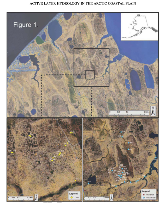
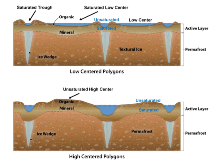
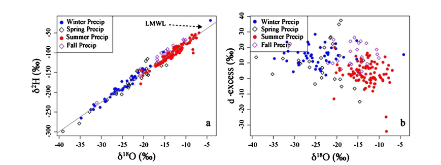
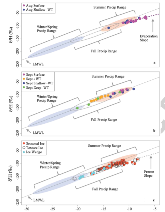
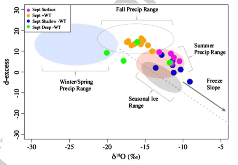
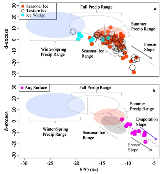
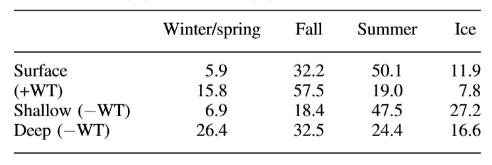
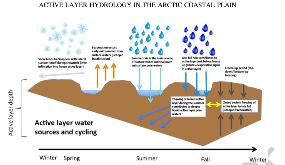
Climate change and thawing permafrost in the Arctic will significantly alter landscape hydro-geomorphology and the distribution of soil moisture, which will have cascading effects on climate feedbacks (CO2 and CH4) and plant and microbial communities. Fundamental processes critical to predicting active layer hydrology are not well understood. This study applied water stable isotope techniques (δ2H and δ18O) to infer sources and mixing of active layer waters in a polygonal tundra landscape in Barrow, Alaska (USA), in August and September of 2012. Results suggested that winter precipitation did not contribute substantially to surface waters or subsurface active layer pore waters measured in August and September. Summer rain was the main source of water to the active layer, with seasonal ice melt contributing to deeper pore waters later in the season. Surface water evaporation was evident in August from a characteristic isotopic fractionation slope (δ2H vs δ18O). Freeze-out isotopic fractionation effects in frozen active layer samples and textural permafrost were indistinguishable from evaporation fractionation, emphasizing the importance of considering the most likely processes in water isotope studies, in systems where both evaporation and freeze-out occur in close proximity. The fractionation observed in frozen active layer ice was not observed in liquid active layer pore waters. Such a discrepancy between frozen and liquid active layer samples suggests mixing of meltwater, likely due to slow melting of seasonal ice. In conclusion, this research provides insight into fundamental processes relating to sources and mixing of active layer waters, which should be considered in process-based fine-scale and intermediate-scale hydrologic models.
Throckmorton, Heather M., et al. "Active layer hydrology in an arctic tundra ecosystem: quantifying water sources and cycling using water stable isotopes." Hydrological Processes, vol. 30, no. 26, Apr. 2016. https://doi.org/10.1002/hyp.10883
Throckmorton, Heather M., Newman, Brent D., Heikoop, Jeffrey M., Perkins, George B., Feng, Xiahong, Graham, David E., O'Malley, Daniel, Vesselinov, Velimir V., Young, Jessica, Wullschleger, Stan D., & Wilson, Cathy J. (2016). Active layer hydrology in an arctic tundra ecosystem: quantifying water sources and cycling using water stable isotopes. Hydrological Processes, 30(26). https://doi.org/10.1002/hyp.10883
Throckmorton, Heather M., Newman, Brent D., Heikoop, Jeffrey M., et al., "Active layer hydrology in an arctic tundra ecosystem: quantifying water sources and cycling using water stable isotopes," Hydrological Processes 30, no. 26 (2016), https://doi.org/10.1002/hyp.10883
@article{osti_1345775,
  author       = {Throckmorton, Heather M. and Newman, Brent D. and Heikoop, Jeffrey M. and Perkins, George B. and Feng, Xiahong and Graham, David E. and O'Malley, Daniel and Vesselinov, Velimir V. and Young, Jessica and Wullschleger, Stan D. and others},
  title        = {Active layer hydrology in an arctic tundra ecosystem: quantifying water sources and cycling using water stable isotopes},
  annote       = {Climate change and thawing permafrost in the Arctic will significantly alter landscape hydro-geomorphology and the distribution of soil moisture, which will have cascading effects on climate feedbacks (CO2 and CH4) and plant and microbial communities. Fundamental processes critical to predicting active layer hydrology are not well understood. This study applied water stable isotope techniques (δ2H and δ18O) to infer sources and mixing of active layer waters in a polygonal tundra landscape in Barrow, Alaska (USA), in August and September of 2012. Results suggested that winter precipitation did not contribute substantially to surface waters or subsurface active layer pore waters measured in August and September. Summer rain was the main source of water to the active layer, with seasonal ice melt contributing to deeper pore waters later in the season. Surface water evaporation was evident in August from a characteristic isotopic fractionation slope (δ2H vs δ18O). Freeze-out isotopic fractionation effects in frozen active layer samples and textural permafrost were indistinguishable from evaporation fractionation, emphasizing the importance of considering the most likely processes in water isotope studies, in systems where both evaporation and freeze-out occur in close proximity. The fractionation observed in frozen active layer ice was not observed in liquid active layer pore waters. Such a discrepancy between frozen and liquid active layer samples suggests mixing of meltwater, likely due to slow melting of seasonal ice. In conclusion, this research provides insight into fundamental processes relating to sources and mixing of active layer waters, which should be considered in process-based fine-scale and intermediate-scale hydrologic models.},
  doi          = {10.1002/hyp.10883},
  url          = {https://www.osti.gov/biblio/1345775},
  journal      = {Hydrological Processes},
  issn         = {ISSN 0885-6087},
  number       = {26},
  volume       = {30},
  place        = {United States},
  publisher    = {Wiley},
  year         = {2016},
  month        = {04}}
Throckmorton, Heather; Wilson, Cathy; Heikoop, Jeff
Next Generation Ecosystems Experiment - Arctic, Oak Ridge National Laboratory (ORNL), Oak Ridge, TN (US); NGEE Arctic, Oak Ridge National Laboratory (ORNL), Oak Ridge, TN (United States)https://doi.org/10.5440/1164892