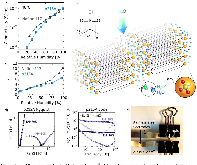
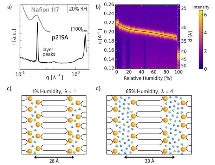
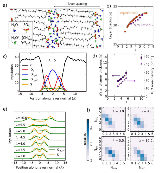
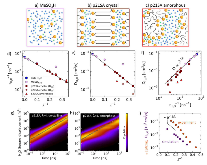
Recent advances in polymer synthesis have allowed remarkable control over chain microstructure and conformation. Capitalizing on such developments, we create well-controlled chain folding in sulfonated polyethylene, leading to highly uniform hydrated acid layers of sub-nanometer thickness with high proton conductivity. The linear polyethylene contains sulfonic acid groups pendant to precisely every 21st carbon atom that induce tight chain folds to form the hydrated layers, while the methylene segments crystallize. The proton conductivity is on par with Nafion® 117, the benchmark for fuel cell membranes. This is the first time that well-controlled hairpin chain folding has been utilized for proton or ion transport, and the first report of high proton conductivity within a crystalline polymer structure. This layered polyethylene-based structure is an innovative and versatile design paradigm for functional polymer membranes, opening doors to efficient and selective transport of other ions and small molecules upon appropriate selection of functional groups.
Trigg, Edward B., Gaines, Taylor W., Maréchal, Manuel, et al., "Self-assembled highly ordered acid layers in precisely sulfonated polyethylene produce efficient proton transport," Nature Materials 17, no. 8 (2018), https://doi.org/10.1038/s41563-018-0097-2
@article{osti_1473945,
  author       = {Trigg, Edward B. and Gaines, Taylor W. and Maréchal, Manuel and Moed, Demi E. and Rannou, Patrice and Wagener, Kenneth B. and Stevens, Mark J. and Winey, Karen I.},
  title        = {Self-assembled highly ordered acid layers in precisely sulfonated polyethylene produce efficient proton transport},
  annote       = {Recent advances in polymer synthesis have allowed remarkable control over chain microstructure and conformation. Capitalizing on such developments, we create well-controlled chain folding in sulfonated polyethylene, leading to highly uniform hydrated acid layers of sub-nanometer thickness with high proton conductivity. The linear polyethylene contains sulfonic acid groups pendant to precisely every 21st carbon atom that induce tight chain folds to form the hydrated layers, while the methylene segments crystallize. The proton conductivity is on par with Nafion® 117, the benchmark for fuel cell membranes. This is the first time that well-controlled hairpin chain folding has been utilized for proton or ion transport, and the first report of high proton conductivity within a crystalline polymer structure. This layered polyethylene-based structure is an innovative and versatile design paradigm for functional polymer membranes, opening doors to efficient and selective transport of other ions and small molecules upon appropriate selection of functional groups.},
  doi          = {10.1038/s41563-018-0097-2},
  url          = {https://www.osti.gov/biblio/1473945},
  journal      = {Nature Materials},
  issn         = {ISSN 1476-1122},
  number       = {8},
  volume       = {17},
  place        = {United States},
  publisher    = {Springer Nature - Nature Publishing Group},
  year         = {2018},
  month        = {05}}
WIRMS 2009 5TH INTERNATIONAL WORKSHOP ON INFRARED MICROSCOPY AND SPECTROSCOPY WITH ACCELERATOR BASED SOURCES, AIP Conference Proceedingshttps://doi.org/10.1063/1.3326356