Advanced EMT and Phasor-Domain Hybrid Simulation with Simulation Mode Switching Capability for Transmission and Distribution Systems
Journal Article
·
· IEEE Transactions on Power Systems
- Pacific Northwest National Lab. (PNNL), Richland, WA (United States). Electricity Infrastructure Group
- Arizona State Univ., Tempe, AZ (United States). Dept. of Electrical, Computer and Energy Engineering
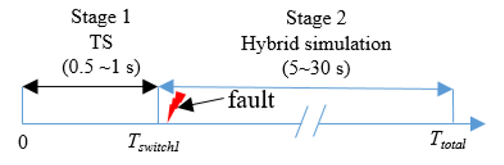
Conventional electromagnetic transient (EMT) and phasor-domain hybrid simulation approaches presently exist for trans-mission system level studies. Their simulation efficiency is generally constrained by the EMT simulation. With an increasing number of distributed energy resources and non-conventional loads being installed in distribution systems, it is imperative to extend the hybrid simulation application to include distribution systems and integrated transmission and distribution systems. Meanwhile, it is equally important to improve the simulation efficiency as the modeling scope and complexity of the detailed system in the EMT simulation increases. To meet both requirements, this paper introduces an advanced EMT and phasor-domain hybrid simulation approach. This approach has two main features: 1) a comprehensive phasor-domain modeling framework which supports positive-sequence, three-sequence, three-phase and mixed three-sequence/three-phase representations and 2) a robust and flexible simulation mode switching scheme. The developed scheme enables simulation switching from hybrid simulation mode back to pure phasor-domain dynamic simulation mode to achieve significantly improved simulation efficiency. The proposed method has been tested on integrated transmission and distribution systems. In conclusion, the results show that with the developed simulation switching feature, the total computational time is significantly reduced compared to running the hybrid simulation for the whole simulation period, while maintaining good simulation accuracy.
- Research Organization:
- Pacific Northwest National Laboratory (PNNL), Richland, WA (United States)
- Sponsoring Organization:
- National Science Foundation (NSF); USDOE
- Grant/Contract Number:
- AC05-76RL01830
- OSTI ID:
- 1438246
- Alternate ID(s):
- OSTI ID: 1489203
- Report Number(s):
- PNNL-SA--126907
- Journal Information:
- IEEE Transactions on Power Systems, Journal Name: IEEE Transactions on Power Systems Journal Issue: 6 Vol. 33; ISSN 0885-8950
- Publisher:
- IEEECopyright Statement
- Country of Publication:
- United States
- Language:
- English


Similar Records
Advanced EMT and Phasor-Domain Hybrid Simulation With Simulation Mode Switching Capability for Transmission and Distribution Systems
Phasor-Domain Modeling of Inverter Based Resources Considering Unbalanced Grid Faults
An Electromagnetic Transient and Three-Phase Phasor Co-Simulation Platform for Studying Distribution System Transients with High Pentration of DERs
Journal Article
·
Thu Nov 01 00:00:00 EDT 2018
· IEEE Transactions on Power Systems
·
OSTI ID:1489203
Phasor-Domain Modeling of Inverter Based Resources Considering Unbalanced Grid Faults
Conference
·
Fri Oct 04 00:00:00 EDT 2024
·
OSTI ID:2537874
An Electromagnetic Transient and Three-Phase Phasor Co-Simulation Platform for Studying Distribution System Transients with High Pentration of DERs
Conference
·
Mon Sep 25 00:00:00 EDT 2023
·
OSTI ID:2310925