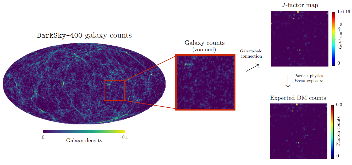
Dark matter in the halos surrounding galaxy groups and clusters can annihilate to high-energy photons. Recent advancements in the construction of galaxy group catalogs provide many thousands of potential extragalactic targets for dark matter. In this paper, we outline a procedure to infer the dark matter signal associated with a given galaxy group. Applying this procedure to a catalog of sources, one can create a full-sky map of the brightest extragalactic dark matter targets in the nearby Universe (z≲0.03), supplementing sources of dark matter annihilation from within the local group. As with searches for dark matter in dwarf galaxies, these extragalactic targets can be stacked together to enhance the signals associated with dark matter. We validate this procedure on mock Fermi gamma-ray data sets using a galaxy catalog constructed from the DarkSky N-body cosmological simulation and demonstrate that the limits are robust, at O(1) levels, to systematic uncertainties on halo mass and concentration. We also quantify other sources of systematic uncertainty arising from the analysis and modeling assumptions. Lastly, our results suggest that a stacking analysis using galaxy group catalogs provides a powerful opportunity to discover extragalactic dark matter and complements existing studies of Milky Way dwarf galaxies.
Lisanti, Mariangela, et al. "Mapping extragalactic dark matter annihilation with galaxy surveys: A systematic study of stacked group searches." Physical Review. D., vol. 97, no. 6, Mar. 2018. https://doi.org/10.1103/physrevd.97.063005
Lisanti, Mariangela, Mishra-Sharma, Siddharth, Rodd, Nicholas L., Safdi, Benjamin R., & Wechsler, Risa H. (2018). Mapping extragalactic dark matter annihilation with galaxy surveys: A systematic study of stacked group searches. Physical Review. D., 97(6). https://doi.org/10.1103/physrevd.97.063005
Lisanti, Mariangela, Mishra-Sharma, Siddharth, Rodd, Nicholas L., et al., "Mapping extragalactic dark matter annihilation with galaxy surveys: A systematic study of stacked group searches," Physical Review. D. 97, no. 6 (2018), https://doi.org/10.1103/physrevd.97.063005
@article{osti_1437174,
  author       = {Lisanti, Mariangela and Mishra-Sharma, Siddharth and Rodd, Nicholas L. and Safdi, Benjamin R. and Wechsler, Risa H.},
  title        = {Mapping extragalactic dark matter annihilation with galaxy surveys: A systematic study of stacked group searches},
  annote       = {Dark matter in the halos surrounding galaxy groups and clusters can annihilate to high-energy photons. Recent advancements in the construction of galaxy group catalogs provide many thousands of potential extragalactic targets for dark matter. In this paper, we outline a procedure to infer the dark matter signal associated with a given galaxy group. Applying this procedure to a catalog of sources, one can create a full-sky map of the brightest extragalactic dark matter targets in the nearby Universe (z≲0.03), supplementing sources of dark matter annihilation from within the local group. As with searches for dark matter in dwarf galaxies, these extragalactic targets can be stacked together to enhance the signals associated with dark matter. We validate this procedure on mock Fermi gamma-ray data sets using a galaxy catalog constructed from the DarkSky N-body cosmological simulation and demonstrate that the limits are robust, at O(1) levels, to systematic uncertainties on halo mass and concentration. We also quantify other sources of systematic uncertainty arising from the analysis and modeling assumptions. Lastly, our results suggest that a stacking analysis using galaxy group catalogs provides a powerful opportunity to discover extragalactic dark matter and complements existing studies of Milky Way dwarf galaxies.},
  doi          = {10.1103/physrevd.97.063005},
  url          = {https://www.osti.gov/biblio/1437174},
  journal      = {Physical Review. D.},
  issn         = {ISSN 2470-0010},
  number       = {6},
  volume       = {97},
  place        = {United States},
  publisher    = {American Physical Society (APS)},
  year         = {2018},
  month        = {03}}
Oak Ridge National Laboratory (ORNL), Oak Ridge, TN (United States). Oak Ridge Leadership Computing Facility (OLCF); Princeton Univ., NJ (United States); SLAC National Accelerator Laboratory (SLAC), Menlo Park, CA (United States)
Sponsoring Organization:
USDOE Office of Science (SC), High Energy Physics (HEP) (SC-25)
Grant/Contract Number:
AC02-76SF00515; SC0007968; SC0013999
OSTI ID:
1437174
Alternate ID(s):
OSTI ID: 1600953 OSTI ID: 1425246
Journal Information:
Physical Review. D., Journal Name: Physical Review. D. Journal Issue: 6 Vol. 97; ISSN PRVDAQ; ISSN 2470-0010
Nuclear Instruments and Methods in Physics Research Section A: Accelerators, Spectrometers, Detectors and Associated Equipment, Vol. 551, Issue 2-3https://doi.org/10.1016/j.nima.2005.05.068