Climate extremes, land–climate feedbacks and land-use forcing at 1.5°C
Journal Article
·
· Philosophical Transactions of the Royal Society. A, Mathematical, Physical and Engineering Sciences
more »
- ETH Zurich, Zurich (Switzerland)
- Max-Planck Institute for Meteorology, Hamburg (Germany)
- PBL Netherlands Environmental Assessment Agency, Bilthoven (The Netherlands); Utrecht Univ., Utrecht (The Netherlands)
- CICERO, Oslo (Norway)
- Pacific Northwest National Lab. (PNNL), Richland, WA (United States)
- PBL Netherlands Environmental Assessment Agency, Bilthoven (The Netherlands)
- International Institute for Applied Systems Analysis (IIASA), Laxenburg (Austria)
- Potsdam Institute for Climate Impact Research (PIK), Potsdam (Germany)
- School of Geographical Sciences, Bristol (United Kingdom)
- ETH Zurich, Zurich (Switzerland); International Institute for Applied Systems Analysis (IIASA), Laxenburg (Austria)
- Potsdam Institute for Climate Impact Research (PIK), Potsdam (Germany); Climate Analytics, Berlin (Germany)
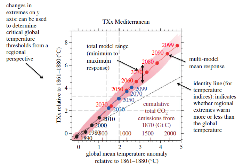
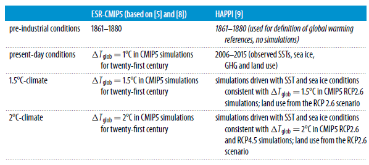
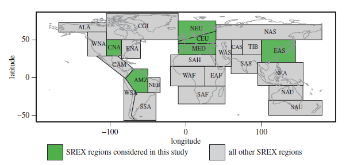
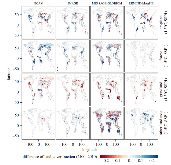
Here, this article investigates projected changes in temperature and water cycle extremes at 1.5°C of global warming, and highlights the role of land processes and land-use changes (LUCs) for these projections. We provide new comparisons of changes in climate at 1.5°C versus 2°C based on empirical sampling analyses of transient simulations versus simulations from the ‘Half a degree Additional warming, Prognosis and Projected Impacts’ (HAPPI) multi-model experiment. The two approaches yield similar overall results regarding changes in climate extremes on land, and reveal a substantial difference in the occurrence of regional extremes at 1.5°C versus 2°C. Land processes mediated through soil moisture feedbacks and land-use forcing play a major role for projected changes in extremes at 1.5°C in most mid-latitude regions, including densely populated areas in North America, Europe and Asia. This has important implications for low-emissions scenarios derived from integrated assessment models (IAMs), which include major LUCs in ambitious mitigation pathways (e.g. associated with increased bioenergy use), but are also shown to differ in the simulated LUC patterns. Biogeophysical effects from LUCs are not considered in the development of IAM scenarios, but play an important role for projected regional changes in climate extremes, and are thus of high relevance for sustainable development pathways.
- Research Organization:
- Pacific Northwest National Laboratory (PNNL), Richland, WA (United States)
- Sponsoring Organization:
- USDOE
- Grant/Contract Number:
- AC05-76RL01830
- OSTI ID:
- 1437030
- Alternate ID(s):
- OSTI ID: 1455294
- Report Number(s):
- PNNL-SA--131570
- Journal Information:
- Philosophical Transactions of the Royal Society. A, Mathematical, Physical and Engineering Sciences, Journal Name: Philosophical Transactions of the Royal Society. A, Mathematical, Physical and Engineering Sciences Journal Issue: 2119 Vol. 376; ISSN 1364-503X
- Publisher:
- The Royal Society PublishingCopyright Statement
- Country of Publication:
- United States
- Language:
- English






Similar Records
Climate extremes, land–climate feedbacks and land-use forcing at 1.5°C
Biogeophysical Impacts of Land-Use Change on Climate Extremes in Low-Emission Scenarios: Results From HAPPI-Land
Journal Article
·
Mon Apr 02 00:00:00 EDT 2018
· Philosophical Transactions of the Royal Society. A, Mathematical, Physical and Engineering Sciences
·
OSTI ID:1455294
Biogeophysical Impacts of Land-Use Change on Climate Extremes in Low-Emission Scenarios: Results From HAPPI-Land
Journal Article
·
Mon Feb 12 19:00:00 EST 2018
· Earth's Future
·
OSTI ID:1544313