U.S. Department of Energy
Office of Scientific and Technical Information

Distinct Contributions of Ice Nucleation, Large-Scale Environment, and Shallow Cumulus Detrainment to Cloud Phase Partitioning With NCAR CAM5

Journal Article · · Journal of Geophysical Research: Atmospheres
DOI:https://doi.org/10.1002/2017JD027213· OSTI ID:1433940
 [1];  [2];  [3];  [3]
  1. Tsinghua Univ., Beijing (China). Dept. of Earth System Science; Univ. of Wyoming, Laramie, WY (United States). Dept. of Atmospheric Science
  2. Univ. of Wyoming, Laramie, WY (United States). Dept. of Atmospheric Science; Brookhaven National Lab. (BNL), Upton, NY (United States)
  3. Univ. of Wyoming, Laramie, WY (United States). Dept. of Atmospheric Science
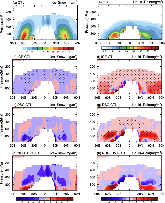
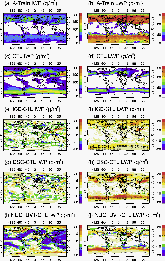
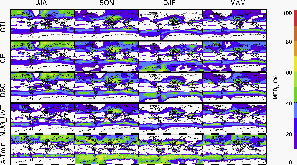
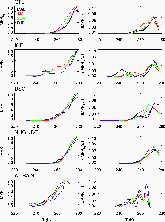
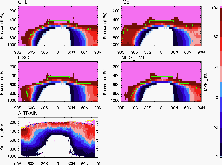
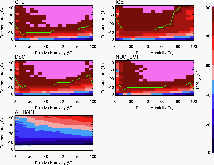
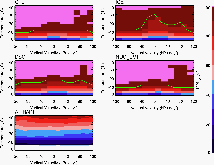
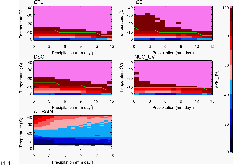
Mixed-phase clouds containing both liquid droplets and ice particles occur frequently at high latitudes and in the midlatitude storm track regions. Simulations of the cloud phase partitioning between liquid and ice hydrometeors in state-of-the-art global climate models are still associated with large biases. For this study, the phase partitioning in terms of liquid mass phase ratio (MPRliq, defined as the ratio of liquid mass to total condensed water mass) simulated from the NCAR Community Atmosphere Model version 5 (CAM5) is evaluated against the observational data from A-Train satellite remote sensors. Modeled MPRliq is significantly lower than observations on the global scale, especially in the Southern Hemisphere (e.g., Southern Ocean and the Antarctic). Sensitivity tests with CAM5 are conducted to investigate the distinct contributions of heterogeneous ice nucleation, shallow cumulus detrainment, and large-scale environment (e.g., winds, temperature, and water vapor) to the low MPRliq biases. Our results show that an aerosol-aware ice nucleation parameterization increases the MPRliq especially at temperatures colder than -20°C and significantly improves the model agreements with observations in the Polar regions in summer. The decrease of threshold temperature over which all detrained cloud water is liquid from 268 to 253 K enhances the MPRliq and improves the MPRliq mostly over the Southern Ocean. By constraining water vapor in CAM5 toward reanalysis, modeled low biases in many geographical regions are largely reduced through a significant decrease of cloud ice mass mixing ratio.
Research Organization:
Brookhaven National Laboratory (BNL), Upton, NY (United States)
Sponsoring Organization:
National Key Research and Development Program (China); National Natural Science Foundation of China (NSFC); USDOE Office of Science (SC), Biological and Environmental Research (BER) (SC-23)
Grant/Contract Number:
SC0012704; SC0014239
OSTI ID:
1433940
Report Number(s):
BNL--203496-2018-JAAM
Journal Information:
Journal of Geophysical Research: Atmospheres, Journal Name: Journal of Geophysical Research: Atmospheres Journal Issue: 2 Vol. 123; ISSN 2169-897X
Publisher:
American Geophysical UnionCopyright Statement
Country of Publication:
United States
Language:
English

References (70)

A computationally efficient description of heterogeneous freezing: A simplified version of the Soccer ball model: NIEDERMEIER ET AL. journal January 2014
On the relationships among cloud cover, mixed-phase partitioning, and planetary albedo in GCMs: CLOUD COVER, MIXED-PHASE, AND ALBEDO journal May 2016
Evidence for secondary ice production in Southern Ocean open cellular convection: Secondary Ice Production over the Southern Ocean journal April 2017
The ERA-Interim reanalysis: configuration and performance of the data assimilation system journal April 2011
On dynamic and thermodynamic components of cloud changes journal March 2004
Importance of the mixed-phase cloud distribution in the control climate for assessing the response of clouds to carbon dioxide increase: a multi-model study journal April 2006
A comparison of low-latitude cloud properties and their response to climate change in three AGCMs sorted into regimes using mid-tropospheric vertical velocity journal May 2006
Mixed phase cloud water/ice structure from high spatial resolution satellite data journal January 2004
CloudSat mission: Performance and early science after the first year of operation journal January 2008
Evolution of the ice phase in tropical altocumulus: SAMUM lidar observations over Cape Verde journal January 2009
Cloud influence on and response to seasonal Arctic sea ice loss journal January 2009
Combined CloudSat-CALIPSO-MODIS retrievals of the properties of ice clouds journal January 2010
Occurrence, liquid water content, and fraction of supercooled water clouds from combined CALIOP/IIR/MODIS measurements journal January 2010
Global simulations of ice nucleation and ice supersaturation with an improved cloud scheme in the Community Atmosphere Model journal January 2010
Comparison of Arctic clouds between European Center for Medium-Range Weather Forecasts simulations and Atmospheric Radiation Measurement Climate Research Facility long-term observations at the North Slope of Alaska Barrow site journal January 2010
Microphysics parameterization for convective clouds in a global climate model: Description and single-column model tests journal January 2011
Representation of Arctic mixed-phase clouds and the Wegener-Bergeron-Findeisen process in climate models: Perspectives from a cloud-resolving study journal January 2011
Comparisons and analyses of aircraft and satellite observations for wintertime mixed-phase clouds journal January 2011
Evidence that ice forms primarily in supercooled liquid clouds at temperatures > −27°C: ICE NUCLEATION IN MID-LEVEL CLOUDS journal July 2011
Ice aspect ratio influences on mixed-phase clouds: Impacts on phase partitioning in parcel models: ICE ASPECT INFLUENCES ON CLOUDS journal November 2011
A search for large-scale effects of ship emissions on clouds and radiation in satellite data: SHIP EMISSION INFLUENCE ON CLOUDS journal December 2011
Constraining the influence of natural variability to improve estimates of global aerosol indirect effects in a nudged version of the Community Atmosphere Model 5: ESTIMATES OF AEROSOL INDIRECT EFFECTS journal December 2012
C02 and climate: a missing feedback? journal September 1989
The importance of feldspar for ice nucleation by mineral dust in mixed-phase clouds journal June 2013
Resilience of persistent Arctic mixed-phase clouds journal December 2011
Ice nucleation by particles immersed in supercooled cloud droplets journal January 2012
Predicting global atmospheric ice nuclei distributions and their impacts on climate journal June 2010
Space observations of cold-cloud phase change journal June 2010
Sensitivity of climate simulations to the parameterization of cumulus convection in the Canadian climate centre general circulation model journal September 1995
Immersion freezing by natural dust based on a soccer ball model with the Community Atmospheric Model version 5: climate effects journal December 2014
The MODIS cloud products: algorithms and examples from terra journal February 2003
Observational constraints on mixed-phase clouds imply higher climate sensitivity journal April 2016
Ice nucleation parameterization for global models [Ice nucleation parameterization for global models] journal September 2005
New Primary Ice-Nucleation Parameterizations in an Explicit Cloud Model journal July 1992
The Role of Contact Nucleation in Ice Phase Initiation in Clouds journal April 1974
Global Precipitation at One-Degree Daily Resolution from Multisatellite Observations journal February 2001
Testing IWC Retrieval Methods Using Radar and Ancillary Measurements with In Situ Data journal January 2008
Cloud Liquid Water Path from Satellite-Based Passive Microwave Observations: A New Climatology over the Global Oceans journal April 2008
A New Two-Moment Bulk Stratiform Cloud Microphysics Scheme in the Community Atmosphere Model, Version 3 (CAM3). Part I: Description and Numerical Tests journal August 2008
A New Moist Turbulence Parameterization in the Community Atmosphere Model journal June 2009
The University of Washington Shallow Convection and Moist Turbulence Schemes and Their Impact on Climate Simulations with the Community Atmosphere Model journal June 2009
The CALIPSO Mission: A Global 3D View of Aerosols and Clouds journal September 2010
Clouds at Arctic Atmospheric Observatories. Part II: Thermodynamic Phase Characteristics journal March 2011
A Classical-Theory-Based Parameterization of Heterogeneous Ice Nucleation by Mineral Dust, Soot, and Biological Particles in a Global Climate Model journal August 2010
THE CLOUDSAT MISSION AND THE A-TRAIN: A New Dimension of Space-Based Observations of Clouds and Precipitation journal December 2002
The Retrieval of Ice Water Content from Radar Reflectivity Factor and Temperature and Its Use in Evaluating a Mesoscale Model
  • Hogan, Robin J.; Mittermaier, Marion P.; Illingworth, Anthony J.
  • Journal of Applied Meteorology and Climatology, Vol. 45, Issue 2 https://doi.org/10.1175/JAM2340.1
journal February 2006
An Arctic Springtime Mixed-Phase Cloudy Boundary Layer Observed during SHEBA journal January 2005
A Physically Based Subgrid Parameterization for the Production and Maintenance of Mixed-Phase Clouds in a General Circulation Model journal January 2016
Sensitivity Study on the Influence of Cloud Microphysical Parameters on Mixed-Phase Cloud Thermodynamic Phase Partitioning in CAM5 journal February 2016
Limitations of the Wegener–Bergeron–Findeisen Mechanism in the Evolution of Mixed-Phase Clouds journal September 2007
Computing and Partitioning Cloud Feedbacks Using Cloud Property Histograms. Part II: Attribution to Changes in Cloud Amount, Altitude, and Optical Depth journal June 2012
Evaluation of Microphysics Parameterization for Convective Clouds in the NCAR Community Atmosphere Model CAM5 journal December 2012
Observed Southern Ocean Cloud Properties and Shortwave Reflection. Part II: Phase Changes and Low Cloud Feedback journal December 2014
Global Climate Impacts of Fixing the Southern Ocean Shortwave Radiation Bias in the Community Earth System Model (CESM) journal June 2016
Inclusion of Ice Microphysics in the NCAR Community Atmospheric Model Version 3 (CAM3) journal September 2007
Characteristics of mixed-phase clouds. I: Lidar, radar and aircraft observations from CLARE'98 journal July 2003
Processes limiting the emergence of detectable aerosol indirect effects on tropical warm clouds in global aerosol-climate model and satellite data journal January 2014
Cloud microphysics and aerosol indirect effects in the global climate model ECHAM5-HAM text January 2007
Technical note: On the use of nudging for aerosol-climate model intercomparison studies text January 2014
Monte Carlo-based subgrid parameterization of vertical velocity and stratiform cloud microphysics in ECHAM5.5-HAM2 journal January 2013
Different contact angle distributions for heterogeneous ice nucleation in the Community Atmospheric Model version 5 journal January 2014
Technical Note: On the use of nudging for aerosol–climate model intercomparison studies journal January 2014
The source of discrepancies in aerosol–cloud–precipitation interactions between GCM and A-Train retrievals journal January 2016
Direct comparisons of ice cloud macro- and microphysical properties simulated by the Community Atmosphere Model version 5 with HIPPO aircraft observations journal January 2017
Cloud microphysics and aerosol indirect effects in the global climate model ECHAM5-HAM journal January 2007
Toward a minimal representation of aerosols in climate models: description and evaluation in the Community Atmosphere Model CAM5 journal January 2012
Description and evaluation of a new four-mode version of the Modal Aerosol Module (MAM4) within version 5.3 of the Community Atmosphere Model journal January 2016
Different contact angle distributions for heterogeneous ice nucleation in the community atmospheric model version 5 text January 2014
An A-Train Satellite Based Stratiform Mixed-Phase Cloud Retrieval Algorithm by Combining Active and Passive Sensor Measurements journal November 2013

Cited By (2)

Impacts of Representing Heterogeneous Distribution of Cloud Liquid and Ice on Phase Partitioning of Arctic Mixed‐Phase Clouds with NCAR CAM5 journal December 2019
Comparison of Antarctic and Arctic Single‐Layer Stratiform Mixed‐Phase Cloud Properties Using Ground‐Based Remote Sensing Measurements journal September 2019

Figures / Tables (14)


Similar Records

Testing cloud microphysics parameterizations in NCAR CAM5 with ISDAC and M-PACE observations
Journal Article · Fri Dec 23 23:00:00 EST 2011 · Journal of Geophysical Research · OSTI ID:1043371

Application of an Online-Coupled Regional Climate Model, WRF-CAM5, over East Asia for Examination of Ice Nucleation Schemes: Part I. Comprehensive Model Evaluation and Trend Analysis for 2006 and 2011
Journal Article · Tue Aug 18 00:00:00 EDT 2015 · Climate · OSTI ID:1344065

Testing Cloud Microphysics Parameterizations in NCAR CAM5 with ISDAC and M-PACE Observations
Journal Article · Fri Dec 23 23:00:00 EST 2011 · Journal of Geophysical Research. D. (Atmospheres) · OSTI ID:1032683