Constraints on Cosmological Parameters from the Angular Power Spectrum of a Combined 2500 deg2 SPT-SZ and Planck Gravitational Lensing Map
Journal Article
·
· The Astrophysical Journal (Online)
more »
- McGill Univ., Montreal, QC (Canada)
- McGill Univ., Montreal, QC (Canada); Stanford Univ., Stanford, CA (United States)
- Univ. of California, Davis, CA (United States)
- Univ. of Pennsylvania, Philadelphia, PA (United States); Univ. of Chicago, Chicago, IL (United States)
- Univ. of Chicago, Chicago, IL (United States); Fermi National Accelerator Lab. (FNAL), Batavia, IL (United States)
- Univ. of Chicago, Chicago, IL (United States); Argonne National Lab. (ANL), Argonne, IL (United States)
- SLAC National Accelerator Lab., Menlo Park, CA (United States)
- Univ. of Chicago, Chicago, IL (United States)
- Univ. of Chicago, Chicago, IL (United States); California Inst. of Technology (CalTech), Pasadena, CA (United States)
- McGill Univ., Montreal, QC (Canada); Univ. of California, Berkeley, CA (United States)
- McGill Univ., Montreal, QC (Canada); Canadian Institute for Advanced Research, Toronto, ON (Canada)
- Univ. of Colorado, Boulder, CO (United States)
- Univ. of California, Berkeley, CA (United States); European Southern Observatory, Garching (Germany)
- Univ. of California, Berkeley, CA (United States)
- McGill Univ., Montreal, QC (Canada); Canadian Institute for Advanced Research, Toronto, ON (Canada); Univ. of Illinois at Urbana-Champaign, Urbana, IL (United States)
- Univ. of California, Berkeley, CA (United States); Lawrence Berkeley National Lab. (LBNL), Berkeley, CA (United States)
- Univ. of Michigan, Ann Arbor, MI (United States)
- Ludwig-Maximilians-Univ., Munchen (Germany); Excellence Cluster Universe, Garching (Germany); Max-Planck-Institut fur extraterrestrische Physik, Garching (Germany)
- Univ. of Chicago, Chicago, IL (United States); Univ. of Toronto, Toronto, ON (Canada)
- Univ. of Minnesota, Minneapolis, MN (United States)
- Univ. of California, Berkeley, CA (United States); Univ. of Melbourne, Parkville, VIC (Australia)
- Case Western Reserve Univ., Cleveland, OH (United States)
- Univ. of Colorado, Boulder, CO (United States); Case Western Reserve Univ., Cleveland, OH (United States)
- Univ. of Chicago, Chicago, IL (United States); School of the Art Institute of Chicago, Chicago, IL (United States)
- Univ. of Chicago, Chicago, IL (United States); Univ. of California, Berkeley, CA (United States)
- Case Western Reserve Univ., Cleveland, OH (United States); California Inst. of Technology (CalTech), Pasadena, CA (United States)
- Harvard-Smithsonian Center for Astrophysics, Cambridge, MA (United States)
- Stanford Univ., Stanford, CA (United States); Univ. of Chicago, Chicago, IL (United States)
- Univ. of Toronto, Toronto, ON (Canada)
- Univ. of Illinois at Urbana-Champaign, Urbana, IL (United States)
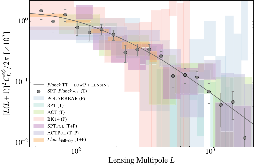
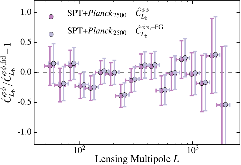
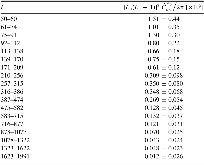
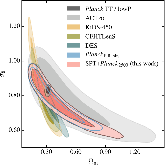
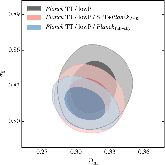
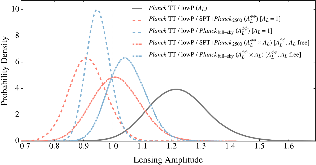
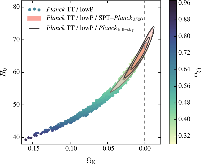
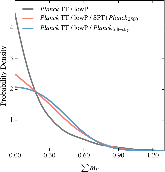
Here, we report constraints on cosmological parameters from the angular power spectrum of a cosmic microwave background (CMB) gravitational lensing potential map created using temperature data from 2500 deg$^2$ of South Pole Telescope (SPT) data supplemented with data from Planck in the same sky region, with the statistical power in the combined map primarily from the SPT data. We fit the corresponding lensing angular power spectrum to a model including cold dark matter and a cosmological constant ($$\Lambda$$CDM), and to models with single-parameter extensions to $$\Lambda$$CDM. We find constraints that are comparable to and consistent with constraints found using the full-sky Planck CMB lensing data. Specifically, we find $$\sigma_8 \Omega_{\rm m}^{0.25}=0.598 \pm 0.024$$ from the lensing data alone with relatively weak priors placed on the other $$\Lambda$$CDM parameters. In combination with primary CMB data from Planck, we explore single-parameter extensions to the $$\Lambda$$CDM model. We find $$\Omega_k = -0.012^{+0.021}_{-0.023}$$ or $$M_{\nu}< 0.70$$eV both at 95% confidence, all in good agreement with results that include the lensing potential as measured by Planck over the full sky. We include two independent free parameters that scale the effect of lensing on the CMB: $$A_{L}$$, which scales the lensing power spectrum in both the lens reconstruction power and in the smearing of the acoustic peaks, and $$A^{\phi \phi}$$, which scales only the amplitude of the CMB lensing reconstruction power spectrum. We find $$A^{\phi \phi} \times A_{L} =1.01 \pm 0.08$$ for the lensing map made from combined SPT and Planck temperature data, indicating that the amount of lensing is in excellent agreement with what is expected from the observed CMB angular power spectrum when not including the information from smearing of the acoustic peaks.
- Research Organization:
- Argonne National Lab. (ANL), Argonne, IL (United States); Argonne National Laboratory (ANL), Argonne, IL (United States); Fermi National Accelerator Laboratory (FNAL), Batavia, IL (United States); Lawrence Berkeley National Laboratory (LBNL), Berkeley, CA (United States); SLAC National Accelerator Laboratory (SLAC), Menlo Park, CA (United States)
- Sponsoring Organization:
- Gordon and Betty Moore Foundation; National Science Foundation (NSF); Natural Sciences and Engineering Research Council of Canada (NSERC); USDOE Office of Science (SC), High Energy Physics (HEP) (SC-25)
- Contributing Organization:
- SPT
- Grant/Contract Number:
- AC02-05CH11231; AC02-06CH11357; AC02-07CH11359
- OSTI ID:
- 1431574
- Alternate ID(s):
- OSTI ID: 1460984
OSTI ID: 1490702
- Report Number(s):
- FERMILAB-PUB--17-608-AE; arXiv:1712.07541; 1644334
- Journal Information:
- The Astrophysical Journal (Online), Journal Name: The Astrophysical Journal (Online) Journal Issue: 2 Vol. 860; ISSN 1538-4357
- Publisher:
- Institute of Physics (IOP)Copyright Statement
- Country of Publication:
- United States
- Language:
- English
Similar Records
Constraints on Cosmological Parameters from the 500 deg$^2$ SPTpol Lensing Power Spectrum
Journal Article
·
Tue Oct 15 00:00:00 EDT 2019
· TBD
·
OSTI ID:1574975