Parameterization of Large Variability Using the Hyper-Dual Meta-Model
Journal Article
·
· Journal of Verification, Validation and Uncertainty Quantification
- Univ. of Wisconsin-Madison, Madison, WI (United States)
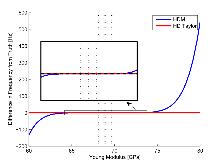
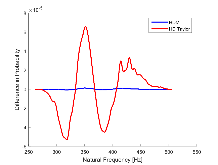
One major problem in the design of aerospace components is the nonlinear changes in the response due to a change in the geometry and material properties. Many of these components have small nominal values and any change can lead to a large variability. In order to characterize this large variability, traditional methods require either many simulation runs or the calculations of many higher order derivatives. Each of these paths requires a large amount of computational power to evaluate the response curve. In order to perform uncertainty quantification analysis, even more simulation runs are required. The hyper-dual meta-model is introduced and used to characterize the response curve with the use of basis functions. The information of the response is generated with the utilization of the hyper-dual step to determine the sensitivities at a few number of simulation runs to greatly enrich the response space. This study shows the accuracy of this method for two different systems with parameterizations at different stages in the design analysis.
- Research Organization:
- Sandia National Laboratories (SNL-NM), Albuquerque, NM (United States)
- Sponsoring Organization:
- USDOE National Nuclear Security Administration (NNSA)
- Grant/Contract Number:
- AC04-94AL85000
- OSTI ID:
- 1429755
- Report Number(s):
- SAND--2017-3216J; 652047
- Journal Information:
- Journal of Verification, Validation and Uncertainty Quantification, Journal Name: Journal of Verification, Validation and Uncertainty Quantification Journal Issue: 1 Vol. 3; ISSN 2377-2158
- Publisher:
- ASMECopyright Statement
- Country of Publication:
- United States
- Language:
- English








Similar Records
Parameterized reduced-order models using hyper-dual numbers.
Model reduction for hypersonic aerodynamics via conservative LSPG projection and hyper-reduction
Determining Reduced Order Models for Optimal Stochastic Reduced Order Models
Technical Report
·
Tue Oct 01 00:00:00 EDT 2013
·
OSTI ID:1104705
Model reduction for hypersonic aerodynamics via conservative LSPG projection and hyper-reduction
Conference
·
Sat Jan 04 23:00:00 EST 2020
· AIAA Scitech Forum
·
OSTI ID:1619242
Determining Reduced Order Models for Optimal Stochastic Reduced Order Models
Technical Report
·
Sat Aug 01 00:00:00 EDT 2015
·
OSTI ID:1212810