Free energy change of a dislocation due to a Cottrell atmosphere
Journal Article
·
· Philosophical Magazine (2003, Print)
- Sandia National Lab. (SNL-CA), Livermore, CA (United States); Stanford Univ., CA (United States). Dept. of Mechanical Engineering
- Stanford Univ., CA (United States). Dept. of Mechanical Engineering
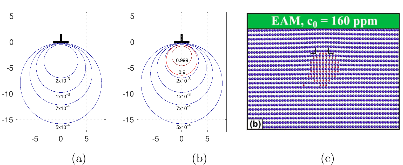
The free energy reduction of a dislocation due to a Cottrell atmosphere of solutes is computed using a continuum model. In this work, we show that the free energy change is composed of near-core and far-field components. The far-field component can be computed analytically using the linearized theory of solid solutions. Near the core the linearized theory is inaccurate, and the near-core component must be computed numerically. The influence of interactions between solutes in neighbouring lattice sites is also examined using the continuum model. We show that this model is able to reproduce atomistic calculations of the nickel–hydrogen system, predicting hydride formation on dislocations. The formation of these hydrides leads to dramatic reductions in the free energy. Lastly, the influence of the free energy change on a dislocation’s line tension is examined by computing the equilibrium shape of a dislocation shear loop and the activation stress for a Frank–Read source using discrete dislocation dynamics.
- Research Organization:
- Sandia National Laboratories (SNL-NM), Albuquerque, NM (United States)
- Sponsoring Organization:
- USDOE National Nuclear Security Administration (NNSA); USDOE Office of Science (SC), Basic Energy Sciences (BES) (SC-22). Materials Sciences & Engineering Division
- Grant/Contract Number:
- AC04-94AL85000; NA0003525; SC0010412
- OSTI ID:
- 1426811
- Report Number(s):
- SAND--2018-2133J; 661000
- Journal Information:
- Philosophical Magazine (2003, Print), Journal Name: Philosophical Magazine (2003, Print) Journal Issue: 16 Vol. 98; ISSN 1478-6435
- Publisher:
- Taylor & FrancisCopyright Statement
- Country of Publication:
- United States
- Language:
- English
Multiscale analysis of hydrogen-induced softening in f.c.c. nickel single crystals oriented for multiple-slips: elastic screening effect
|
journal | September 2019 |
Influence of hydrogen core force shielding on dislocation junctions in iron
|
journal | March 2020 |


Similar Records
Molecular dynamics study of hydrogen Cottrell atmosphere in aluminum: Influence of solute-solute interactions in the dislocation core
Molecular Statics Analyses of Thermodynamics and Kinetics of Hydrogen Cottrell Atmosphere Formation Around Edge Dislocations in Aluminum
Journal Article
·
Wed May 15 20:00:00 EDT 2024
· Physical Review Materials
·
OSTI ID:2588852
Molecular Statics Analyses of Thermodynamics and Kinetics of Hydrogen Cottrell Atmosphere Formation Around Edge Dislocations in Aluminum
Journal Article
·
Wed May 20 20:00:00 EDT 2020
· JOM. Journal of the Minerals, Metals & Materials Society
·
OSTI ID:1639049