Potential seal bypass and caprock storage produced by deformation-band-to-opening-mode-fracture transition at the reservoir/caprock interface
- New Mexico Tech., Socorro, NM (United States). Dept. of Earth and Environmental Science
- Utah State Univ., Logan, UT (United States). Dept. of Geology
- Sandia National Lab. (SNL-NM), Albuquerque, NM (United States)
- Los Alamos National Lab. (LANL), Los Alamos, NM (United States)
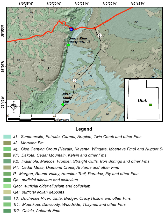
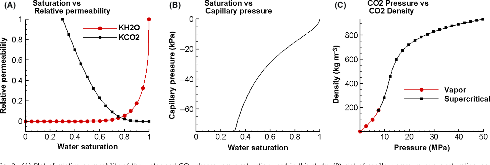
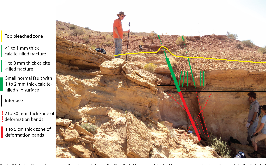
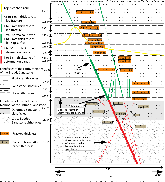
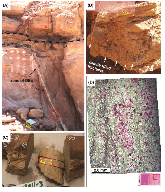
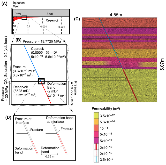
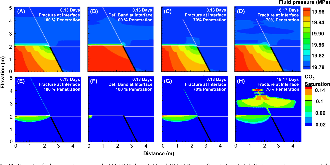
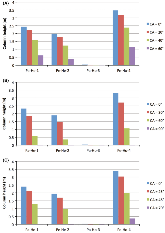
Here, we examined the potential impact on CO2 transport of zones of deformation bands in reservoir rock that transition to opening-mode fractures within overlying caprock. Sedimentological and petrophysical measurements were collected along an approximately 5 m × 5 m outcrop of the Slick Rock and Earthy Members of the Entrada Sandstone on the eastern flank of the San Rafael Swell, Utah, USA. Measured deformation band permeability (2 mD) within the reservoir facies is about three orders of magnitude lower than the host sandstone. Average permeability of the caprock facies (0.0005 mD) is about seven orders of magnitude lower than the host sandstone. Aperture-based permeability estimates of the opening-mode caprock fractures are high (3.3 × 10⁷ mD). High-resolution CO2–H2O transport models incorporate these permeability data at the millimeter scale. We then varied fault properties at the reservoir/caprock interface between open fractures and deformation bands as part of a sensitivity study. Numerical modeling results suggest that zones of deformation bands within the reservoir strongly compartmentalize reservoir pressures largely blocking lateral, cross-fault flow of supercritical CO2. Significant vertical CO2 transport into the caprock occurred in some scenarios along opening-mode fractures. The magnitude of this vertical CO2 transport depends on the small-scale geometry of the contact between the opening-mode fracture and the zone of deformation bands, as well as the degree to which fractures penetrate caprock. Finally, the presence of relatively permeable units within the caprock allows storage of significant volumes of CO2, particularly when the fracture network does not extend all the way through the caprock.
- Research Organization:
- Energy Frontier Research Centers (EFRC) (United States). Center for Frontiers of Subsurface Energy Security (CFSES); Los Alamos National Lab. (LANL), Los Alamos, NM (United States); Sandia National Laboratories (SNL-NM), Albuquerque, NM (United States)
- Sponsoring Organization:
- USDOE; USDOE National Nuclear Security Administration (NNSA); USDOE Office of Science (SC), Basic Energy Sciences (BES) (SC-22)
- Grant/Contract Number:
- AC04-94AL85000; AC52-06NA25396; FE0004844; SC0001114
- OSTI ID:
- 1416301
- Alternate ID(s):
- OSTI ID: 1400767
OSTI ID: 1497662
- Report Number(s):
- LA-UR--17-27584; SAND--2017-1967J
- Journal Information:
- Geofluids, Journal Name: Geofluids Journal Issue: 4 Vol. 16; ISSN 1468-8115
- Publisher:
- HindawiCopyright Statement
- Country of Publication:
- United States
- Language:
- English
Characterizing the Impact of Fractured Caprock Heterogeneity on Supercritical CO$$_2$$ Injection
|
journal | November 2019 |
Characteristics of bleaching around major structures in a reservoir-cap rock system, SE Utah, USA
|
journal | January 2020 |

Similar Records
Area of Interest 1, CO2 at the Interface: Nature and Dynamics of the Reservoir/Caprock Contact and Implications for Carbon Storage Performance
Analysis of Potential Leakage Pathways and Mineralization within Caprocks for Geologic Storage of CO2
Technical Report
·
Fri Oct 31 00:00:00 EDT 2014
·
OSTI ID:1177773
Analysis of Potential Leakage Pathways and Mineralization within Caprocks for Geologic Storage of CO2
Technical Report
·
Wed May 01 00:00:00 EDT 2013
·
OSTI ID:1087719