Solution Phase Exciton Diffusion Dynamics of a Charge-Transfer Copolymer PTB7 and a Homopolymer P3HT
- Argonne National Lab. (ANL), Argonne, IL (United States); Energy Frontier Research Centers (EFRC) (United States). Argonne-Northwestern Solar Energy Research Center (ANSER); Northwestern Univ., Evanston, IL (United States); Chonnam National Univ., Gwangju (Korea)
- Argonne National Lab. (ANL), Argonne, IL (United States); Energy Frontier Research Centers (EFRC) (United States). Argonne-Northwestern Solar Energy Research Center (ANSER); Northwestern Univ., Evanston, IL (United States)
- Univ. of Chicago, IL (United States)
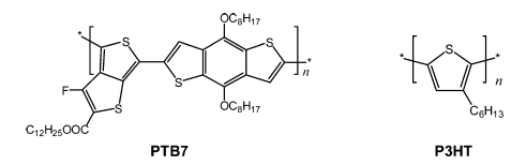
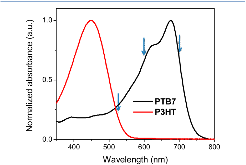
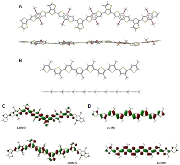
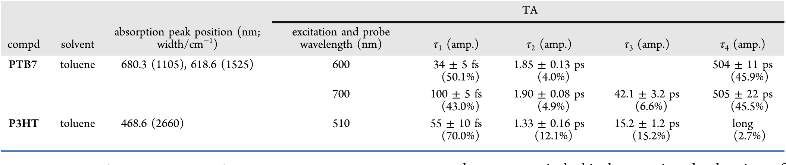
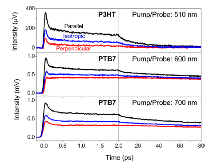
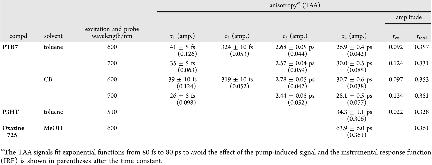
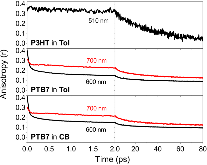
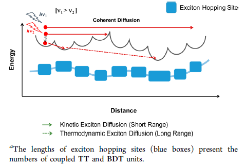
Using ultrafast polarization-controlled transient absorption (TA) measurements, dynamics of the initial exciton states were investigated in this work on the time scale of tens of femtoseconds to about 80 ps in two different types of conjugated polymers extensively used in active layers of organic photovoltaic devices. These polymers are poly(3-fluorothienothiophenebenzodithiophene) (PTB7) and poly-3-hexylthiophene (P3HT), which are charge-transfer polymers and homopolymers, respectively. In PTB7, the initial excitons with excess vibrational energy display two observable ultrafast time constants, corresponding to coherent exciton diffusion before the vibrational relaxation, and followed by incoherent exciton diffusion processes to a neighboring local state after the vibrational relaxation. In contrast, P3HT shows only one exciton diffusion or conformational motion time constant of 34 ps, even though its exciton decay kinetics are multiexponential. Based on the experimental results, an exciton dynamics mechanism is conceived taking into account the excitation energy and structural dependence in coherent and incoherent exciton diffusion processes, as well as other possible deactivation processes including the formation of the pseudo-charge-transfer and charge separate states, as well as interchain exciton hopping or coherent diffusion.
- Research Organization:
- Energy Frontier Research Centers (EFRC) (United States). Argonne-Northwestern Solar Energy Research Center (ANSER)
- Sponsoring Organization:
- USDOE Office of Science (SC), Basic Energy Sciences (BES). Chemical Sciences, Geosciences & Biosciences Division; National Research Foundation of Korea (NRF)
- Grant/Contract Number:
- SC0001059; AC02-06CH11357
- OSTI ID:
- 1210442
- Alternate ID(s):
- OSTI ID: 1384811
OSTI ID: 1393970
- Journal Information:
- Journal of Physical Chemistry. B, Condensed Matter, Materials, Surfaces, Interfaces and Biophysical Chemistry, Journal Name: Journal of Physical Chemistry. B, Condensed Matter, Materials, Surfaces, Interfaces and Biophysical Chemistry Journal Issue: 24 Vol. 119; ISSN 1520-6106
- Publisher:
- American Chemical SocietyCopyright Statement
- Country of Publication:
- United States
- Language:
- English
Preferential Charge Generation at Aggregate Sites in Narrow Band Gap Infrared Photoresponsive Polymer Semiconductors
|
journal | February 2018 |
Modifying electronic properties of ICBA through chemical substitutions for solar cell applications
|
journal | February 2017 |
Push–pull architecture eliminates chain length effects on exciton dissociation
|
journal | January 2018 |
Morphology-dependent performance of thin film organic solar cells
|
journal | October 2018 |
Similar Records
The separation of vibrational coherence from ground- and excited-electronic states in P3HT film
Photoinduced Charge Carrier Generation in a Poly(3-hexylthiophene) and Methanofullerene Bulk Heterojunction Investigated by Time-Resolved Terahertz Spectroscopy
Related Subjects
bio-inspired
catalysis (heterogeneous)
catalysis (homogeneous)
charge transport
defects
diffusion
electrodes - solar
energy
excitons
hydrogen and fuel cells
materials and chemistry by design
membrane
optics
organic polymers
photosynthesis (natural and artificial)
polarization
solar (fuels)
solar (photovoltaic)
spin dynamics
synthesis (novel materials)
synthesis (self-assembly)